Authors build a LinkedIn audience in the 90 days before a book launch by posting the book's ideas two to five times a week, turning their warm network into a launch team, and giving readers a reason to engage before they are asked to pre-order. The pre-order ask comes last, after the audience already trusts the author's thinking.
Pre-orders are hard. Attention is short, launch windows are long, and "pre-order now" gets old fast. Here is a 90-day plan, with public examples from authors who used LinkedIn well.
TLDR
- Start 90 days out. Pre-orders count toward first-week sales, so the months before launch decide how the book enters the market.
- Post the book's ideas, not just the book. Two to five posts a week from the manuscript builds reach and trust.
- Bridge the gap with a lead magnet, such as a guide, an assessment, or bonus content tied to the book's core idea.
- Build a segmented launch team and tell people exactly what to post, when to post it, and why it matters.
- Earn Trust Before Hello: make the clear pre-order ask in the final two weeks, once the audience is warm.
Why Do the 90 Days Before a Book Launch Matter So Much?
The 90 days before a book launch matter because pre-orders and launch-week sales are counted together, and that first week shapes how retailers, publishers, and bestseller lists treat the book.
BookPal, a reporting bookseller, explains that U.S. bestseller lists ask booksellers to hold sales until the Monday after publication, so all pre-orders, "sometimes six or seven months' worth," roll up into that first week. Penguin Random House tells its authors that the pre-order quantity is a good early indicator of a book's success and can lead retailers to increase their initial orders.
Jane Friedman, a longtime publishing industry analyst, defines author platform as "an ability to sell books because of who you are or who you can reach."
"Being able to repeatedly reach and speak to people who know you and trust you is meaningful." Jane Friedman, on author platform
Dorie Clark, author of The Long Game, has written in Harvard Business Review that successfully launching a book is harder than authors expect. For business and leadership books, LinkedIn is where those readers already spend their workday.
What Should Authors Post on LinkedIn in the 90 Days Before Launch?
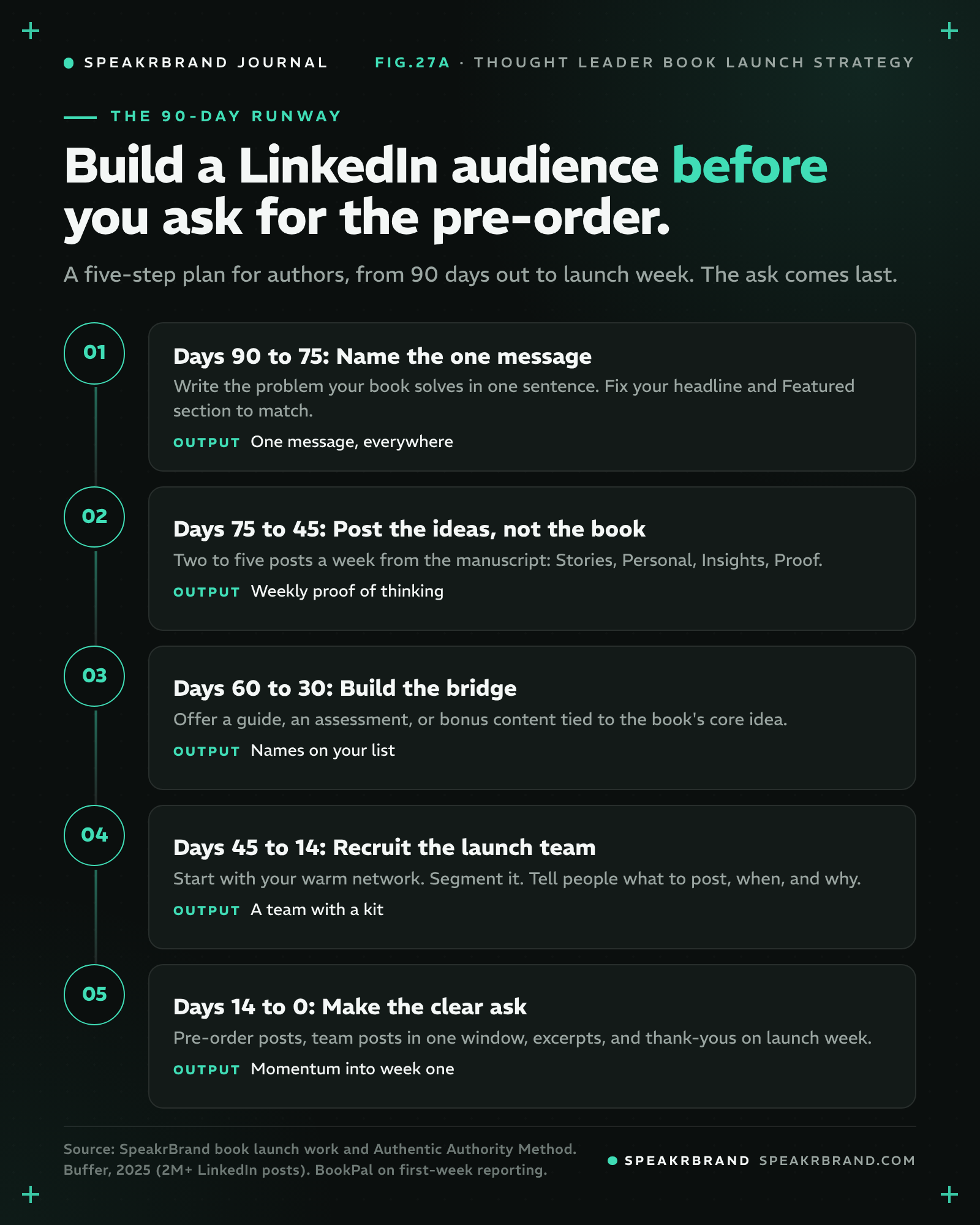
FIG.27A · A 90-day LinkedIn plan for authors before a book launch. Tap to open full size.
Authors should post the ideas inside the book, two to five times a week, in a mix of stories, personal moments, insights, and proof. Each post should repeat the one problem the book solves.
Frequency helps. In a 2025 analysis of more than 2 million posts from 94,000+ accounts, Buffer found that moving from one LinkedIn post a week to two to five posts a week added about 1,182 impressions per post and lifted engagement rate by 0.23 percentage points.
Depth matters too. The 2024 Edelman and LinkedIn B2B Thought Leadership Impact Report found that 52% of decision-makers spend an hour or more a week reading thought leadership, and 75% said a specific piece of thought leadership led them to research something they had not been considering. Readers want the idea before they want the book.
SpeakrBrand's Authentic Authority method gives the mix: Stories (30%), Personal (20%), Insights (30%), and Proof (20%). For an author, Stories are scenes from the manuscript, Personal posts show why the book exists, Insights teach one idea from a chapter, and Proof shares early reader reactions. For the Stories bucket, see how personal LinkedIn stories start conversations.
Excerpts also work as posts. Adam Grant shared an excerpt from Hidden Potential for the LinkedIn Book Club, opening with a question readers face at work.
How Do Authors Turn Their LinkedIn Network Into a Launch Team?
Authors turn their network into a launch team by segmenting warm relationships into circles, reaching each circle more than once, and giving every member a specific ask with ready-made assets. People usually want to help. They need direction.
| Circle | Who is in it | How you reach them | The specific ask |
|---|---|---|---|
| Inner circle | Close friends, family, longtime clients, collaborators | A personal call, text, or voice note | Pre-order, read the early copy, post in the launch window |
| Warm network | Colleagues, past clients, groups and communities you belong to | A short email sequence, several touches | Pre-order and share a ready-to-copy post on launch week |
| LinkedIn audience | Followers, connections, newsletter subscribers | Weekly posts and a LinkedIn newsletter | Get the free guide or assessment now, pre-order in the final two weeks |
| Peers with reach | Authors, hosts, and leaders your readers already follow | A personal note and an early copy | Share one line from the book that stayed with them |
Source: SpeakrBrand book launch work. On a phone, swipe the table sideways to see every column.
Speaker and author Lisa Nichols announced pre-orders for her book Something Extra and invited anyone who wanted to join the launch team to message her with their email address. Author Demi-Leigh Tebow gave her audience three steps to join her launch team: pre-order, fill out a form, then read the book and post a review.
Dorie Clark described a more systematic version on the Published Author podcast: one email invited readers to join, a click tagged them, and an automated sequence asked them to pre-order, sent an early copy, and explained where and how to post honest reviews on launch day.
Peers with reach belong on the list as well. Before Hidden Potential came out, Charles Duhigg posted a pre-order link for Adam Grant's book, and Arianna Huffington shared a line she loved along with the publication date and a pre-order link. One line, shared by someone readers already follow, carries real weight.
In one launch SpeakrBrand supported, dozens of people posted about the book inside the same three-day window, because the team had a shared folder of captions, graphics, and the pre-order link, plus clear instructions.
Tell your launch team what to post, when to post it, and why it matters. Clarity drives activation.
What Gives Readers a Reason to Engage Before They Pre-Order?
A lead magnet gives readers a reason to engage before they are ready to pre-order. A practical guide, a short assessment, or bonus content lets the author talk about the book's problem without asking for the sale in every post.
Author Julie Bee used this approach for her book Burned, offering a pre-order bonus called the BURNED Blueprint, a six-step email and audio course for readers who pre-ordered and completed a short form. A two-minute assessment works the same way: the reader gets a personal result, and the author gets a subscriber.
A LinkedIn newsletter extends that runway inside the platform. According to LinkedIn Help, newsletter subscribers receive push, in-app, and email notifications each time a new edition is published, and new followers are automatically invited to subscribe. A biweekly newsletter built on chapter ideas is a natural home for the lead magnet and, later, the pre-order link.
Your book is the asset. Your lead magnet is the engine.
What Do Authors Usually Get Wrong Before a Book Launch?

FIG.27B · What authors usually try vs. what builds an audience before launch. Tap to open full size.
Authors usually start too late and ask too soon. They begin posting on announcement day, repeat "pre-order now" in every post, and measure success by likes on the cover reveal.
FIG.27B lists seven swaps from SpeakrBrand's work with 350+ thought leaders. The three that matter most: start 90 days out with the book's ideas, hold the pre-order ask until the final weeks, and give each circle a specific ask. For more post angles, the list of top 20 content ideas for business leaders in 2027 translates directly to authors.
Frequently Asked Questions
How early should an author start building a LinkedIn audience before a book launch?
An author should start at least 90 days before the launch. Ninety days gives enough time to establish one message, publish 25 or more idea posts, build a lead magnet list, and recruit a launch team.
How often should authors post on LinkedIn before a launch?
Authors should post two to five times a week before a launch. Buffer's 2025 analysis of more than 2 million LinkedIn posts found that cadence improved impressions and engagement per post compared with posting once a week.
What should be in a book launch team kit?
A book launch team kit should include ready-to-copy captions, newsletter blurbs, email copy, graphics, and the pre-order link. It should also state what to post, the launch window dates, and why each action matters.
Should authors ask for pre-orders in every LinkedIn post?
Authors should not ask for pre-orders in every post, because the ask wears out long before launch. Use a lead magnet as the call to action for most of the 90 days, then make the direct pre-order ask in the final two weeks.
A book launch is won in the quiet months before anyone can buy the book. That is the heart of SpeakrBrand's Thought Leader Book Launch Strategy. If you want help building that LinkedIn runway for your next book, explore SpeakrBrand's LinkedIn and social media marketing for thought leaders or the Thought Leadership Growth Engine. Earn Trust Before Hello, and the pre-orders follow.
Authors build a LinkedIn audience in the 90 days before a book launch by posting the book's ideas two to five times a week, turning their warm network into a launch team, and giving readers a reason to engage before they are asked to pre-order. The pre-order ask comes last, after the audience already trusts the author's thinking.
Pre-orders are hard. Attention is short, launch windows are long, and "pre-order now" gets old fast. Here is a 90-day plan, with public examples from authors who used LinkedIn well.
TLDR
- Start 90 days out. Pre-orders count toward first-week sales, so the months before launch decide how the book enters the market.
- Post the book's ideas, not just the book. Two to five posts a week from the manuscript builds reach and trust.
- Bridge the gap with a lead magnet, such as a guide, an assessment, or bonus content tied to the book's core idea.
- Build a segmented launch team and tell people exactly what to post, when to post it, and why it matters.
- Earn Trust Before Hello: make the clear pre-order ask in the final two weeks, once the audience is warm.
Why Do the 90 Days Before a Book Launch Matter So Much?
The 90 days before a book launch matter because pre-orders and launch-week sales are counted together, and that first week shapes how retailers, publishers, and bestseller lists treat the book.
BookPal, a reporting bookseller, explains that U.S. bestseller lists ask booksellers to hold sales until the Monday after publication, so all pre-orders, "sometimes six or seven months' worth," roll up into that first week. Penguin Random House tells its authors that the pre-order quantity is a good early indicator of a book's success and can lead retailers to increase their initial orders.
Jane Friedman, a longtime publishing industry analyst, defines author platform as "an ability to sell books because of who you are or who you can reach."
"Being able to repeatedly reach and speak to people who know you and trust you is meaningful." Jane Friedman, on author platform
Dorie Clark, author of The Long Game, has written in Harvard Business Review that successfully launching a book is harder than authors expect. For business and leadership books, LinkedIn is where those readers already spend their workday.
What Should Authors Post on LinkedIn in the 90 Days Before Launch?
FIG.27A · A 90-day LinkedIn plan for authors before a book launch. Tap to open full size.
Authors should post the ideas inside the book, two to five times a week, in a mix of stories, personal moments, insights, and proof. Each post should repeat the one problem the book solves.
Frequency helps. In a 2025 analysis of more than 2 million posts from 94,000+ accounts, Buffer found that moving from one LinkedIn post a week to two to five posts a week added about 1,182 impressions per post and lifted engagement rate by 0.23 percentage points.
Depth matters too. The 2024 Edelman and LinkedIn B2B Thought Leadership Impact Report found that 52% of decision-makers spend an hour or more a week reading thought leadership, and 75% said a specific piece of thought leadership led them to research something they had not been considering. Readers want the idea before they want the book.
SpeakrBrand's Authentic Authority method gives the mix: Stories (30%), Personal (20%), Insights (30%), and Proof (20%). For an author, Stories are scenes from the manuscript, Personal posts show why the book exists, Insights teach one idea from a chapter, and Proof shares early reader reactions. For the Stories bucket, see how personal LinkedIn stories start conversations.
Excerpts also work as posts. Adam Grant shared an excerpt from Hidden Potential for the LinkedIn Book Club, opening with a question readers face at work.
How Do Authors Turn Their LinkedIn Network Into a Launch Team?
Authors turn their network into a launch team by segmenting warm relationships into circles, reaching each circle more than once, and giving every member a specific ask with ready-made assets. People usually want to help. They need direction.
| Circle | Who is in it | How you reach them | The specific ask |
|---|---|---|---|
| Inner circle | Close friends, family, longtime clients, collaborators | A personal call, text, or voice note | Pre-order, read the early copy, post in the launch window |
| Warm network | Colleagues, past clients, groups and communities you belong to | A short email sequence, several touches | Pre-order and share a ready-to-copy post on launch week |
| LinkedIn audience | Followers, connections, newsletter subscribers | Weekly posts and a LinkedIn newsletter | Get the free guide or assessment now, pre-order in the final two weeks |
| Peers with reach | Authors, hosts, and leaders your readers already follow | A personal note and an early copy | Share one line from the book that stayed with them |
Source: SpeakrBrand book launch work. On a phone, swipe the table sideways to see every column.
Speaker and author Lisa Nichols announced pre-orders for her book Something Extra and invited anyone who wanted to join the launch team to message her with their email address. Author Demi-Leigh Tebow gave her audience three steps to join her launch team: pre-order, fill out a form, then read the book and post a review.
Dorie Clark described a more systematic version on the Published Author podcast: one email invited readers to join, a click tagged them, and an automated sequence asked them to pre-order, sent an early copy, and explained where and how to post honest reviews on launch day.
Peers with reach belong on the list as well. Before Hidden Potential came out, Charles Duhigg posted a pre-order link for Adam Grant's book, and Arianna Huffington shared a line she loved along with the publication date and a pre-order link. One line, shared by someone readers already follow, carries real weight.
In one launch SpeakrBrand supported, dozens of people posted about the book inside the same three-day window, because the team had a shared folder of captions, graphics, and the pre-order link, plus clear instructions.
Tell your launch team what to post, when to post it, and why it matters. Clarity drives activation.
What Gives Readers a Reason to Engage Before They Pre-Order?
A lead magnet gives readers a reason to engage before they are ready to pre-order. A practical guide, a short assessment, or bonus content lets the author talk about the book's problem without asking for the sale in every post.
Author Julie Bee used this approach for her book Burned, offering a pre-order bonus called the BURNED Blueprint, a six-step email and audio course for readers who pre-ordered and completed a short form. A two-minute assessment works the same way: the reader gets a personal result, and the author gets a subscriber.
A LinkedIn newsletter extends that runway inside the platform. According to LinkedIn Help, newsletter subscribers receive push, in-app, and email notifications each time a new edition is published, and new followers are automatically invited to subscribe. A biweekly newsletter built on chapter ideas is a natural home for the lead magnet and, later, the pre-order link.
Your book is the asset. Your lead magnet is the engine.
What Do Authors Usually Get Wrong Before a Book Launch?
FIG.27B · What authors usually try vs. what builds an audience before launch. Tap to open full size.
Authors usually start too late and ask too soon. They begin posting on announcement day, repeat "pre-order now" in every post, and measure success by likes on the cover reveal.
FIG.27B lists seven swaps from SpeakrBrand's work with 350+ thought leaders. The three that matter most: start 90 days out with the book's ideas, hold the pre-order ask until the final weeks, and give each circle a specific ask. For more post angles, the list of top 20 content ideas for business leaders in 2027 translates directly to authors.
Frequently Asked Questions
How early should an author start building a LinkedIn audience before a book launch?
An author should start at least 90 days before the launch. Ninety days gives enough time to establish one message, publish 25 or more idea posts, build a lead magnet list, and recruit a launch team.
How often should authors post on LinkedIn before a launch?
Authors should post two to five times a week before a launch. Buffer's 2025 analysis of more than 2 million LinkedIn posts found that cadence improved impressions and engagement per post compared with posting once a week.
What should be in a book launch team kit?
A book launch team kit should include ready-to-copy captions, newsletter blurbs, email copy, graphics, and the pre-order link. It should also state what to post, the launch window dates, and why each action matters.
Should authors ask for pre-orders in every LinkedIn post?
Authors should not ask for pre-orders in every post, because the ask wears out long before launch. Use a lead magnet as the call to action for most of the 90 days, then make the direct pre-order ask in the final two weeks.
A book launch is won in the quiet months before anyone can buy the book. That is the heart of SpeakrBrand's Thought Leader Book Launch Strategy. If you want help building that LinkedIn runway for your next book, explore SpeakrBrand's LinkedIn and social media marketing for thought leaders or the Thought Leadership Growth Engine. Earn Trust Before Hello, and the pre-orders follow.