


Authentic Authority is a LinkedIn content method that balances two kinds of posts: authentic posts that make people trust a speaker as a person, and authority posts that make them see the speaker as the expert. SpeakrBrand splits that work into four buckets, Stories, Personal, Insights, and Proof, posted in a 30/20/30/20 mix. The goal is simple: by the time an event planner first talks to you, your content has already earned their trust.
SpeakrBrand built the Authentic Authority Method after supporting 350+ thought leaders and generating 200M+ social media impressions for keynote speakers, authors, and founders. The pattern in the feeds we audit repeats. Speakers with deep expertise post dry insight and nobody connects with them. Speakers with big personalities post their lives and nobody hires them. The method exists to fix that imbalance, one post at a time.
TLDR
- Authentic Authority is SpeakrBrand's LinkedIn content method for speakers: people follow the person, and they hire the expert, so a speaker needs both kinds of posts.
- Every post fits one of four buckets: Stories (30%, what you have lived), Personal (20%, who you are), Insights (30%, what you know), and Proof (20%, what you have done).
- The mix matters more now: Originality.ai classified 81.2% of long LinkedIn posts it studied in July 2026 as likely AI-written, so lived experience is what separates a speaker from the feed.
- The method is built to Earn Trust Before Hello, because planners and buying committees vet speakers on LinkedIn long before they reach out.
- Start with a ten-post audit, find your thinnest bucket, and fill it this week.
What Is Authentic Authority?
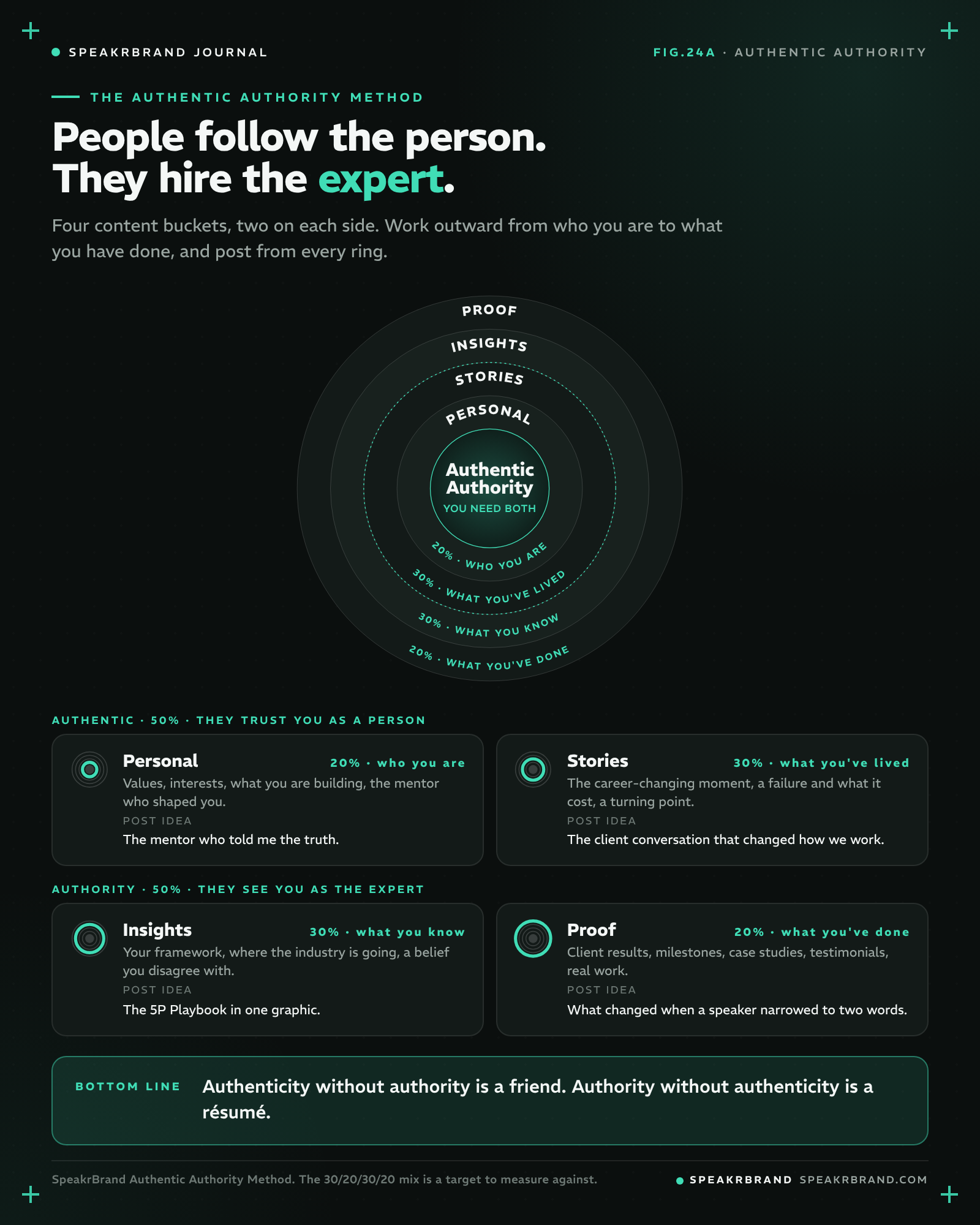
FIG.24A · The Authentic Authority Method: four buckets, two on each side. Tap to open full size.
Authentic Authority is SpeakrBrand's method for marketing a speaker on LinkedIn by pairing authentic content, which builds trust in the person, with authority content, which builds confidence in the expertise. The core idea fits on one line: people follow the person, and they hire the expert. You need both.
The method sorts every post into four buckets, two on each side. On the authentic side, Stories cover what you have lived, such as the career-changing moment or a failure and what it cost, and Personal covers who you are, such as your values, interests, and the mentor who shaped you. On the authority side, Insights cover what you know, such as your framework or a belief you disagree with, and Proof covers what you have done, such as client results, milestones, case studies, and testimonials.
Storytelling is a delivery style that runs through all four buckets. An Insights post can open with a story. A Proof post should almost always be one. The buckets describe what a post proves about the speaker, and the story is how it gets remembered.
Authenticity without authority is a friend. Authority without authenticity is a résumé. Authentic Authority is the balance a buyer needs to say yes.
Authentic Authority also fits inside a larger system. SpeakrBrand's 5P Playbook (Positioning, Presence, Proof, Proximity, Promotion) shows a speaker what to build. Authentic Authority is how you market it, and it powers the Presence and Promotion stages while feeding Proof.
Why Do Keynote Speakers Need Both Authentic and Authority Content?
Keynote speakers need both because event planners judge two things before they book: whether they would enjoy working with the speaker and whether the speaker can deliver for their audience. Authentic content answers the first question. Authority content answers the second. A feed that answers only one leaves the planner guessing on the other.
Leadership research points the same way. In Harvard Business Review, Amy Cuddy, Matthew Kohut, and John Neffinger make the case that leaders should connect first, then lead: warmth earns the trust that lets strength and competence land. A speaker's LinkedIn feed works the same way. Personal and Stories posts create the warmth. Insights and Proof posts show the strength.
Stories carry more weight than facts on their own. Stanford marketing professor Jennifer Aaker's research, summarized by the VMware Women's Leadership Innovation Lab at Stanford, finds that stories shape whether people would hire you, buy from you, or like you.
"Stories are remembered up to 22 times more than facts alone." Jennifer Aaker, Stanford marketing professor
Authority still matters, because buyers reward expertise they can use. In the 2024 LinkedIn and Edelman B2B Thought Leadership Impact research, 9 in 10 decision-makers and C-suite executives said they are more receptive to outreach from a company that consistently produces high-quality thought leadership. For a speaker, that receptiveness shows up as a planner who already knows your point of view when your name lands on the shortlist.
What Goes in Each of the Four Content Buckets?
| Bucket | Share | What it shows | Human signals it draws on | Example speaker post | What it earns |
|---|---|---|---|---|---|
| Stories | 30% | What you have lived | Origin, Struggle | The client conversation that changed how you run your keynote | Memory and connection |
| Personal | 20% | Who you are | Values, Ambition | What you refuse to do on stage, and what it has cost you | Likability and fit |
| Insights | 30% | What you know | Firsthand | A belief in your industry you disagree with, and why | Credibility and recall of your point of view |
| Proof | 20% | What you have done | Firsthand, Real Time | What changed for an audience after your session, told as a story | Confidence to book you |
On a phone, swipe the table sideways to see every column.
Each of the four buckets answers a different question a planner or buyer has about a speaker. Stories answer "Can I relate to this person?" Personal answers "Would I like working with them?" Insights answer "Do they see my audience's problem clearly?" Proof answers "Have they done it before?"
The buckets draw on what SpeakrBrand calls the Six Human Signals: Values, Origin, Firsthand, Struggle, Real Time, and Ambition. These are details no AI model can generate about a person, because they happened to the person. Origin and Struggle feed Stories. Values and Ambition feed Personal. Firsthand experience feeds Insights and Proof. Real Time, what you are working on right now, can feed any bucket.
Here is a Stories post in practice. Conner Krizancic, SpeakrBrand's founder, played quarterback at Ohio University until a fifth concussion ended his athletic career on his 21st birthday. The search for what came next led him to work with keynote speaker Paul Epstein, who asked him a question that changed his direction: "What's the impact behind what you're building?" That post carries Origin and Struggle, and it explains why SpeakrBrand exists without a single line of promotion. For more on why that kind of post starts business conversations, read how keynote speakers can use personal LinkedIn stories to start conversations that lead to business.
Proof is the bucket speakers handle worst, because it slides into announcements. Conner draws the line in a LinkedIn post on announcement-driven versus insight-driven promotion: "I spoke at this event" centers the speaker, while "three lessons I learned from this audience" centers the reader. The second version is still Proof. It just gives the audience a reason to care.
Why Does the 30/20/30/20 Mix Matter More Now That AI Writes So Many Posts?
The 30/20/30/20 mix matters more now because AI has made competent, generic posts cheap, and lived experience is the one input a model cannot supply. A balanced mix forces a speaker to publish the stories, values, and firsthand results that no one else can.
The volume of machine-written content on LinkedIn is no longer a guess. Originality.ai's LinkedIn AI content study classified 81.2% of 5,000 public long-form LinkedIn posts from July 2026 as likely AI-written. When the feed sounds the same, the speaker who shares the moment they almost quit stands out. AI can write the post. It can't live the story.
Buyers say the same thing. The 2026 Edelman-LinkedIn B2B Thought Leadership Impact Report found that 82% of B2B decision-makers say thought leadership is becoming more valuable as AI becomes a common source of business answers. The same report found that 56% said a clear understanding of their challenges did the most to raise their trust in a company, compared with 14% who pointed to the strength of its products or services. For a speaker, that is a direct argument for Insights posts that name the audience's problem over posts that list your credentials.
Search engines are moving in the same direction. Google's guidance on creating helpful, reliable, people-first content asks whether content "clearly demonstrate[s] first-hand expertise and a depth of knowledge." Stories and Proof posts are first-hand by definition, which is why the same material that works on LinkedIn also strengthens a speaker's website and answer-engine visibility.
How Does Authentic Authority Help Speakers Earn Trust Before Hello?

FIG.24B · What speakers try vs. what earns trust before hello. Tap to open full size.
Authentic Authority helps speakers Earn Trust Before Hello by making sure every person who vets them on LinkedIn finds both the human and the expert before the first call. Planners, bureau agents, and buying committees do much of that vetting quietly, and the content has to do the convincing without the speaker in the room.
A lot of that vetting never shows up as a like or a comment. LinkedIn's engineering team has written about using dwell time to improve feed ranking, because click and reaction signals are rare for passive readers. The 2026 Edelman report adds that 89% of decision-makers who shared thought leadership did so through private channels such as email, direct messages, and work chats. The planner who reads your Insights post and forwards it to the selection committee may never react to it at all.
That is why Conner tells speakers to measure content by credibility over likes. Deep Insights posts often get fewer reactions than light personal posts, and they still do the heavier lifting with the right reader. A better test is the one he poses: if an event planner scrolled your feed, would they learn from you?
The profile has to back up the feed. LinkedIn lets members feature samples of their work at the top of the profile, including posts, articles, links, and media. A speaker using Authentic Authority should pin one strong post from each side there: a signature story and a Proof post, plus a speaking reel or website link, so a planner who lands on the profile gets the whole picture in one scroll.
How Should a Speaker Start Using Authentic Authority This Week?
A speaker should start with a ten-post audit, pick the thinnest bucket, and plan the next two weeks of posts to rebalance toward 30/20/30/20. Treat the mix as a target to measure against. The audit usually shows one bucket doing most of the work.
Set a cadence you can keep. Buffer's analysis of more than 2 million posts from 94,000+ LinkedIn accounts found that posting two to five times a week improves reach per post compared with posting once a week. SpeakrBrand's standard calendar runs Monday, Wednesday, and Friday, which gives a speaker roughly three Stories posts, two Personal posts, three Insights posts, and two Proof posts across a 10-post cycle that spans just over three weeks.
Keep promotion in its lane. HubSpot's guidance on building executive presence on LinkedIn recommends that promotional posts make up no more than 25% of an executive's content. Authentic Authority caps Proof at 20%, and asks that most of it arrive as a story about the audience rather than an announcement about the speaker.
When the buckets feel abstract, borrow ideas. SpeakrBrand's list of the Top 20 Content Ideas for Business Leaders in 2027 sorts twenty post ideas into the same four buckets, with a real leader who does each one well, and most of them translate directly to a speaker's feed. Speakers who want the method run for them can see how SpeakrBrand's LinkedIn and social media marketing service builds the interview, calendar, and posts around their own stories.
Try this first
Pull up your last ten LinkedIn posts and label each one Stories, Personal, Insights, or Proof. Count each bucket and compare it to 30/20/30/20. Find your thinnest bucket, then write one post from it this week, using a moment only you were in the room for.
Frequently Asked Questions
What is the Authentic Authority Method in one sentence?
The Authentic Authority Method is SpeakrBrand's LinkedIn content method that balances posts that build trust in a speaker as a person with posts that prove their expertise. It uses four buckets, Stories, Personal, Insights, and Proof, in a 30/20/30/20 mix.
Does a speaker have to hit exactly 30/20/30/20?
No. The 30/20/30/20 mix is a target to measure against over a month or a quarter. A single week can lean one way. The point is to catch the imbalance, such as a feed that is all Insights and no Stories, before it costs you bookings.
How is Authentic Authority different from general personal branding advice?
Authentic Authority gives every post a job: build trust in the person or prove the expertise. General personal branding advice often stops at "be yourself" or "share your expertise," while the method tells a speaker which bucket is thin and what to post next.
How does Authentic Authority relate to the 5P Playbook?
The 5P Playbook (Positioning, Presence, Proof, Proximity, Promotion) shows a speaker what to build, and Authentic Authority is how you market it. The method powers the Presence and Promotion stages and feeds the Proof stage with content buyers can see.
Can speakers use AI with Authentic Authority?
Speakers can use AI to organize, edit, and schedule, but the stories, opinions, and results have to come from the speaker. SpeakrBrand's rule is to use AI for the work and never for the story, because a model cannot invent the lived experience that makes the method work.
Authentic Authority comes down to one habit: before you post, ask which half of your brand the post builds, and whether your feed has been neglecting the other half. Run the ten-post audit this week. If you want a team to run the method with you, from the monthly content interview to the posts themselves, talk to SpeakrBrand.
Authentic Authority is a LinkedIn content method that balances two kinds of posts: authentic posts that make people trust a speaker as a person, and authority posts that make them see the speaker as the expert. SpeakrBrand splits that work into four buckets, Stories, Personal, Insights, and Proof, posted in a 30/20/30/20 mix. The goal is simple: by the time an event planner first talks to you, your content has already earned their trust.
SpeakrBrand built the Authentic Authority Method after supporting 350+ thought leaders and generating 200M+ social media impressions for keynote speakers, authors, and founders. The pattern in the feeds we audit repeats. Speakers with deep expertise post dry insight and nobody connects with them. Speakers with big personalities post their lives and nobody hires them. The method exists to fix that imbalance, one post at a time.
TLDR
- Authentic Authority is SpeakrBrand's LinkedIn content method for speakers: people follow the person, and they hire the expert, so a speaker needs both kinds of posts.
- Every post fits one of four buckets: Stories (30%, what you have lived), Personal (20%, who you are), Insights (30%, what you know), and Proof (20%, what you have done).
- The mix matters more now: Originality.ai classified 81.2% of long LinkedIn posts it studied in July 2026 as likely AI-written, so lived experience is what separates a speaker from the feed.
- The method is built to Earn Trust Before Hello, because planners and buying committees vet speakers on LinkedIn long before they reach out.
- Start with a ten-post audit, find your thinnest bucket, and fill it this week.
What Is Authentic Authority?
FIG.24A · The Authentic Authority Method: four buckets, two on each side. Tap to open full size.
Authentic Authority is SpeakrBrand's method for marketing a speaker on LinkedIn by pairing authentic content, which builds trust in the person, with authority content, which builds confidence in the expertise. The core idea fits on one line: people follow the person, and they hire the expert. You need both.
The method sorts every post into four buckets, two on each side. On the authentic side, Stories cover what you have lived, such as the career-changing moment or a failure and what it cost, and Personal covers who you are, such as your values, interests, and the mentor who shaped you. On the authority side, Insights cover what you know, such as your framework or a belief you disagree with, and Proof covers what you have done, such as client results, milestones, case studies, and testimonials.
Storytelling is a delivery style that runs through all four buckets. An Insights post can open with a story. A Proof post should almost always be one. The buckets describe what a post proves about the speaker, and the story is how it gets remembered.
Authenticity without authority is a friend. Authority without authenticity is a résumé. Authentic Authority is the balance a buyer needs to say yes.
Authentic Authority also fits inside a larger system. SpeakrBrand's 5P Playbook (Positioning, Presence, Proof, Proximity, Promotion) shows a speaker what to build. Authentic Authority is how you market it, and it powers the Presence and Promotion stages while feeding Proof.
Why Do Keynote Speakers Need Both Authentic and Authority Content?
Keynote speakers need both because event planners judge two things before they book: whether they would enjoy working with the speaker and whether the speaker can deliver for their audience. Authentic content answers the first question. Authority content answers the second. A feed that answers only one leaves the planner guessing on the other.
Leadership research points the same way. In Harvard Business Review, Amy Cuddy, Matthew Kohut, and John Neffinger make the case that leaders should connect first, then lead: warmth earns the trust that lets strength and competence land. A speaker's LinkedIn feed works the same way. Personal and Stories posts create the warmth. Insights and Proof posts show the strength.
Stories carry more weight than facts on their own. Stanford marketing professor Jennifer Aaker's research, summarized by the VMware Women's Leadership Innovation Lab at Stanford, finds that stories shape whether people would hire you, buy from you, or like you.
"Stories are remembered up to 22 times more than facts alone." Jennifer Aaker, Stanford marketing professor
Authority still matters, because buyers reward expertise they can use. In the 2024 LinkedIn and Edelman B2B Thought Leadership Impact research, 9 in 10 decision-makers and C-suite executives said they are more receptive to outreach from a company that consistently produces high-quality thought leadership. For a speaker, that receptiveness shows up as a planner who already knows your point of view when your name lands on the shortlist.
What Goes in Each of the Four Content Buckets?
| Bucket | Share | What it shows | Human signals it draws on | Example speaker post | What it earns |
|---|---|---|---|---|---|
| Stories | 30% | What you have lived | Origin, Struggle | The client conversation that changed how you run your keynote | Memory and connection |
| Personal | 20% | Who you are | Values, Ambition | What you refuse to do on stage, and what it has cost you | Likability and fit |
| Insights | 30% | What you know | Firsthand | A belief in your industry you disagree with, and why | Credibility and recall of your point of view |
| Proof | 20% | What you have done | Firsthand, Real Time | What changed for an audience after your session, told as a story | Confidence to book you |
On a phone, swipe the table sideways to see every column.
Each of the four buckets answers a different question a planner or buyer has about a speaker. Stories answer "Can I relate to this person?" Personal answers "Would I like working with them?" Insights answer "Do they see my audience's problem clearly?" Proof answers "Have they done it before?"
The buckets draw on what SpeakrBrand calls the Six Human Signals: Values, Origin, Firsthand, Struggle, Real Time, and Ambition. These are details no AI model can generate about a person, because they happened to the person. Origin and Struggle feed Stories. Values and Ambition feed Personal. Firsthand experience feeds Insights and Proof. Real Time, what you are working on right now, can feed any bucket.
Here is a Stories post in practice. Conner Krizancic, SpeakrBrand's founder, played quarterback at Ohio University until a fifth concussion ended his athletic career on his 21st birthday. The search for what came next led him to work with keynote speaker Paul Epstein, who asked him a question that changed his direction: "What's the impact behind what you're building?" That post carries Origin and Struggle, and it explains why SpeakrBrand exists without a single line of promotion. For more on why that kind of post starts business conversations, read how keynote speakers can use personal LinkedIn stories to start conversations that lead to business.
Proof is the bucket speakers handle worst, because it slides into announcements. Conner draws the line in a LinkedIn post on announcement-driven versus insight-driven promotion: "I spoke at this event" centers the speaker, while "three lessons I learned from this audience" centers the reader. The second version is still Proof. It just gives the audience a reason to care.
Why Does the 30/20/30/20 Mix Matter More Now That AI Writes So Many Posts?
The 30/20/30/20 mix matters more now because AI has made competent, generic posts cheap, and lived experience is the one input a model cannot supply. A balanced mix forces a speaker to publish the stories, values, and firsthand results that no one else can.
The volume of machine-written content on LinkedIn is no longer a guess. Originality.ai's LinkedIn AI content study classified 81.2% of 5,000 public long-form LinkedIn posts from July 2026 as likely AI-written. When the feed sounds the same, the speaker who shares the moment they almost quit stands out. AI can write the post. It can't live the story.
Buyers say the same thing. The 2026 Edelman-LinkedIn B2B Thought Leadership Impact Report found that 82% of B2B decision-makers say thought leadership is becoming more valuable as AI becomes a common source of business answers. The same report found that 56% said a clear understanding of their challenges did the most to raise their trust in a company, compared with 14% who pointed to the strength of its products or services. For a speaker, that is a direct argument for Insights posts that name the audience's problem over posts that list your credentials.
Search engines are moving in the same direction. Google's guidance on creating helpful, reliable, people-first content asks whether content "clearly demonstrate[s] first-hand expertise and a depth of knowledge." Stories and Proof posts are first-hand by definition, which is why the same material that works on LinkedIn also strengthens a speaker's website and answer-engine visibility.
How Does Authentic Authority Help Speakers Earn Trust Before Hello?
FIG.24B · What speakers try vs. what earns trust before hello. Tap to open full size.
Authentic Authority helps speakers Earn Trust Before Hello by making sure every person who vets them on LinkedIn finds both the human and the expert before the first call. Planners, bureau agents, and buying committees do much of that vetting quietly, and the content has to do the convincing without the speaker in the room.
A lot of that vetting never shows up as a like or a comment. LinkedIn's engineering team has written about using dwell time to improve feed ranking, because click and reaction signals are rare for passive readers. The 2026 Edelman report adds that 89% of decision-makers who shared thought leadership did so through private channels such as email, direct messages, and work chats. The planner who reads your Insights post and forwards it to the selection committee may never react to it at all.
That is why Conner tells speakers to measure content by credibility over likes. Deep Insights posts often get fewer reactions than light personal posts, and they still do the heavier lifting with the right reader. A better test is the one he poses: if an event planner scrolled your feed, would they learn from you?
The profile has to back up the feed. LinkedIn lets members feature samples of their work at the top of the profile, including posts, articles, links, and media. A speaker using Authentic Authority should pin one strong post from each side there: a signature story and a Proof post, plus a speaking reel or website link, so a planner who lands on the profile gets the whole picture in one scroll.
How Should a Speaker Start Using Authentic Authority This Week?
A speaker should start with a ten-post audit, pick the thinnest bucket, and plan the next two weeks of posts to rebalance toward 30/20/30/20. Treat the mix as a target to measure against. The audit usually shows one bucket doing most of the work.
Set a cadence you can keep. Buffer's analysis of more than 2 million posts from 94,000+ LinkedIn accounts found that posting two to five times a week improves reach per post compared with posting once a week. SpeakrBrand's standard calendar runs Monday, Wednesday, and Friday, which gives a speaker roughly three Stories posts, two Personal posts, three Insights posts, and two Proof posts across a 10-post cycle that spans just over three weeks.
Keep promotion in its lane. HubSpot's guidance on building executive presence on LinkedIn recommends that promotional posts make up no more than 25% of an executive's content. Authentic Authority caps Proof at 20%, and asks that most of it arrive as a story about the audience rather than an announcement about the speaker.
When the buckets feel abstract, borrow ideas. SpeakrBrand's list of the Top 20 Content Ideas for Business Leaders in 2027 sorts twenty post ideas into the same four buckets, with a real leader who does each one well, and most of them translate directly to a speaker's feed. Speakers who want the method run for them can see how SpeakrBrand's LinkedIn and social media marketing service builds the interview, calendar, and posts around their own stories.
Try this first
Pull up your last ten LinkedIn posts and label each one Stories, Personal, Insights, or Proof. Count each bucket and compare it to 30/20/30/20. Find your thinnest bucket, then write one post from it this week, using a moment only you were in the room for.
Frequently Asked Questions
What is the Authentic Authority Method in one sentence?
The Authentic Authority Method is SpeakrBrand's LinkedIn content method that balances posts that build trust in a speaker as a person with posts that prove their expertise. It uses four buckets, Stories, Personal, Insights, and Proof, in a 30/20/30/20 mix.
Does a speaker have to hit exactly 30/20/30/20?
No. The 30/20/30/20 mix is a target to measure against over a month or a quarter. A single week can lean one way. The point is to catch the imbalance, such as a feed that is all Insights and no Stories, before it costs you bookings.
How is Authentic Authority different from general personal branding advice?
Authentic Authority gives every post a job: build trust in the person or prove the expertise. General personal branding advice often stops at "be yourself" or "share your expertise," while the method tells a speaker which bucket is thin and what to post next.
How does Authentic Authority relate to the 5P Playbook?
The 5P Playbook (Positioning, Presence, Proof, Proximity, Promotion) shows a speaker what to build, and Authentic Authority is how you market it. The method powers the Presence and Promotion stages and feeds the Proof stage with content buyers can see.
Can speakers use AI with Authentic Authority?
Speakers can use AI to organize, edit, and schedule, but the stories, opinions, and results have to come from the speaker. SpeakrBrand's rule is to use AI for the work and never for the story, because a model cannot invent the lived experience that makes the method work.
Authentic Authority comes down to one habit: before you post, ask which half of your brand the post builds, and whether your feed has been neglecting the other half. Run the ten-post audit this week. If you want a team to run the method with you, from the monthly content interview to the posts themselves, talk to SpeakrBrand.


