


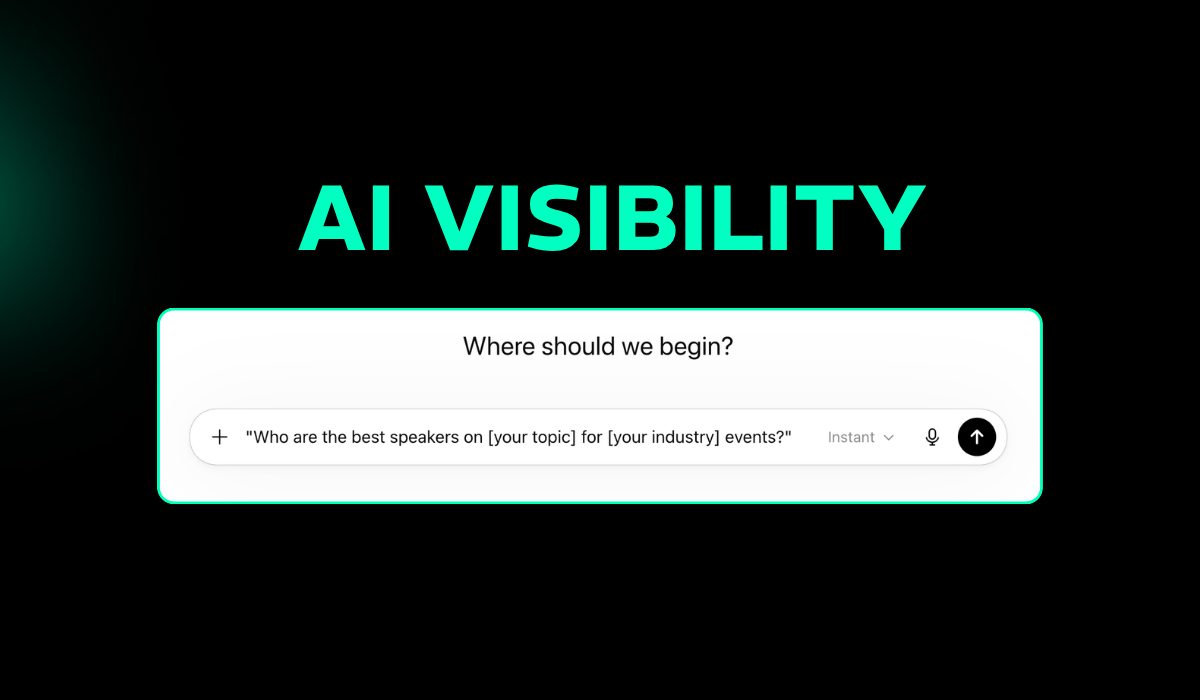
Event planners are no longer building speaker shortlists from a single Google search. They are typing the same query into ChatGPT, Claude, Perplexity, and Gemini, and they are accepting whichever names the AI surfaces as their starting point. The Free AI Visibility Test is a five-minute self-audit that tells any speaker whether they are appearing in those answers, and what to do if they are not.
This shift is the defining change in inbound speaker bookings for 2026. A speaker who ranked well on Google five years ago could expect inquiries from that channel alone. That arrangement is breaking apart in real time. Gartner has projected a 25 percent decline in traditional search engine volume by 2026, with that share migrating to AI chatbots and answer engines. If a speaker is not being cited in those answers, they are not on the shortlist. The Free AI Visibility Test is the fastest way to find out where they actually stand.

TLDR
- Event planners are using ChatGPT, Claude, and Perplexity to build speaker shortlists. If a speaker's name does not surface in those answers, they are functionally invisible to the modern booking process.
- The Free AI Visibility Test is a five-minute audit. Run six variations of "best speakers on [topic] for [industry]" across the major AI tools and record which names appear.
- ChatGPT now serves 900 million weekly active users. Combined with Gemini, Claude, and Perplexity, AI-driven discovery has become the new top of funnel.
- Peer-reviewed Princeton research on Generative Engine Optimization shows quotations, statistics, and citations are the strongest levers for earning AI citations, lifting visibility by 41, 32, and 30 percent respectively.
- The speakers winning in 2026 are not louder. They are more cite-able.
What Is the Free AI Visibility Test and How Does It Work?
The Free AI Visibility Test is a structured query exercise that reveals whether a speaker is being cited as a recommended option inside the AI tools event planners actually use. It takes about five minutes, costs nothing, and produces a clear picture of the speaker's current standing in the AI discovery layer.
The exercise is simple. Open ChatGPT and type: "Who are the best speakers on [your topic] for [your industry] events?" Then repeat the question with five different phrasings: "Top keynote speakers on [topic] 2026," "Who speaks on [topic] for corporate audiences," "Best speaker recommendations for [industry] leadership summit," "Recommended thought leaders on [topic]," and "Who are the most cited experts on [topic]." Run the same six queries through Claude, Perplexity, and Gemini.
Record three data points for each query. First, does the speaker's name appear at all? Second, where in the response does it appear, top, middle, or buried? Third, what context is the AI citing, a book, a podcast appearance, a research report, or a media interview? Those three answers, repeated across four platforms, produce a visibility map that is more actionable than any traditional SEO audit.
"AI citations that do not generate clicks still increase brand awareness, which shows up as branded search growth over time. Speakers who get cited get remembered, even when the AI does not link out."
The test is not about vanity. It is about understanding which channels are actually feeding the speaker's pipeline today versus five years ago. ChatGPT processes over two billion queries per day, and a meaningful share of those are commercial discovery searches that previously happened on Google.
Why Are Event Planners Using AI to Build Speaker Shortlists?
Event planners are using AI because it collapses three days of research into thirty seconds. The traditional shortlist process involved searching Google, browsing speaker bureau directories, asking peers, scanning LinkedIn, and reading a dozen blog posts. AI tools synthesize all of that into a ranked list with rationale, in a single conversation.
The behavioral shift is documented. Search Engine Land's analysis of the Gartner forecast notes that consumer behavior has fundamentally moved from "search and click" to "ask and accept." For high-stakes decisions like booking a keynote speaker, the assist function of AI is even more pronounced. The planner does not want ten options ranked. They want three credible options with reasoning attached.
The implication is that being mentioned by the AI is not the same as being well known. AI tools cite speakers based on the digital footprint they can authoritatively retrieve. That includes published books, research reports, peer-reviewed citations, named media appearances, conference recordings indexed online, and structured content on the speaker's own site. A speaker with a strong real-world reputation but a thin retrievable footprint will be invisible to the AI even when planners would have known their name fifteen years ago.
What Determines Whether AI Tools Will Cite a Speaker?
Peer-reviewed research from Princeton, Georgia Tech, IIT Delhi, and the Allen Institute for AI identifies the specific content characteristics that drive AI citations. The foundational GEO study tested optimization strategies across 10,000 queries in 25 domains. The findings translate directly into a speaker visibility playbook.
Three signals dominate. Adding quotations from named experts increased visibility by 41 percent. Adding sourced statistics increased it by 32 percent. Embedding citations to authoritative sources increased it by 30 percent. A subsequent study analyzing 21,143 citations across ChatGPT, Gemini, and Perplexity confirmed the same pattern at scale. AI tools reward content that looks like research, not content that looks like marketing.

For speakers, this maps to a clear set of priorities. Publish original frameworks or data points that can be cited verbatim. Get quoted in named, reputable publications rather than self-published blogs. Build a body of work that AI tools can pull from when answering a planner's query. The speakers being cited most often in 2026 are the ones who have published the most cite-worthy content over the past three years.
"The win condition in AI search is inclusion in the generated answer, ideally with a citation. Rankings in a list are no longer the goal. Being the source the AI chooses to quote is."
This is why simply having a website is no longer enough. The website has to be structured for retrieval, with clear answers to the questions planners ask, named expert attribution, and statistics that AI can extract as standalone facts.
How Should Speakers Interpret the Results of Their Test?
The Free AI Visibility Test produces one of four outcomes, and each outcome points to a different next step. A speaker who is cited at the top of the response across all four platforms has strong AI authority and should focus on protecting and expanding it. A speaker who appears inconsistently has retrieval problems and needs to clean up their structured digital presence. A speaker who appears only on one platform has a niche moat that can be widened. A speaker who does not appear at all needs to start from foundation.
The most common pattern for established speakers is the third one. They appear on Perplexity or Claude because those tools surface real-time web content more aggressively, but not on ChatGPT, which leans more on its training data and indexed authority. That gap is fixable, but only by publishing the kind of cite-worthy content the Princeton research identified as the visibility drivers.
The other common pattern is more uncomfortable. A speaker who has been booking events for years through bureau relationships discovers they are absent from every AI tool. That speaker has been protected by an older channel that is now declining. The booking flow has shifted around them, and they did not notice because the inbound continued by inertia until it stopped. The Free AI Visibility Test catches that gap before the calendar does.
What Should Speakers Do First If They Fail the Test?
The fastest improvements come from three moves, in this order. First, audit existing content for the three Princeton signals: quotations, statistics, and authoritative citations. Most speaker websites are written in marketing prose with none of these. Rewriting the top ten pages to add named quotes, sourced statistics, and links to peer-reviewed or major publication sources will lift AI visibility within weeks.
Second, publish original research or frameworks the speaker can be cited for. Recent GEO research confirms that original data is the single highest-leverage asset for earning AI citations, because it gives the AI a fact only the speaker's site contains. A short annual report, a survey of the speaker's audience, or a proprietary framework with a memorable name all qualify.
Third, build a quote-able media footprint. Get cited in publications AI tools already trust, including Harvard Business Review, Forbes, Fast Company, McKinsey Quarterly, MIT Sloan Management Review, and trade publications inside the speaker's industry. Industry analyses of AI citation patterns show that authority signals from trusted third-party publications are weighted heavily by every major AI tool.
Frequently Asked Questions
What is the Free AI Visibility Test?
The Free AI Visibility Test is a structured five-minute exercise where speakers run six variations of "best speakers on [topic]" through ChatGPT, Claude, Perplexity, and Gemini, then record whether and where their name appears. It produces a clear baseline of AI discoverability across the four tools event planners most often use.
Why does AI visibility matter for keynote speakers in 2026?
Event planners are using AI tools as their first research step when building speaker shortlists. With ChatGPT alone reaching 900 million weekly active users and Gartner projecting a 25 percent decline in traditional search volume, speakers who are not cited by AI tools are functionally invisible to the modern booking process, regardless of their offline reputation.
What content drives AI tools to cite a speaker?
Peer-reviewed Princeton research on Generative Engine Optimization found that quotations, statistics, and citations are the three strongest drivers of AI visibility, lifting it by 41, 32, and 30 percent respectively. Speakers who publish original research, structured frameworks, and content with named expert attribution are cited more often than those who rely on marketing-style website copy.
How is AI visibility different from SEO?
SEO optimizes for ranking in a list of blue links. AI visibility optimizes for inclusion in a synthesized answer. The two share some underlying signals like authority and credibility, but AI visibility weights structured content, original data, named expert citations, and authoritative third-party mentions far more heavily than traditional SEO does.
How often should speakers run the AI Visibility Test?
Speakers should run the test quarterly at minimum. AI tools update their training data and retrieval indexes constantly, and a speaker's relative visibility can shift meaningfully in a single quarter. Quarterly testing creates a longitudinal record that surfaces both gains from new content and losses from competitor activity.
Can a speaker improve AI visibility without spending money?
Yes. The highest-leverage moves are content moves: adding named quotations to existing website pages, embedding sourced statistics, citing authoritative third-party publications, and publishing original frameworks with memorable names. These cost time, not money, and produce measurable lifts in AI citation rates within weeks.
Run the Test This Week. Build From What You Find.
The speakers winning in 2026 are not the loudest ones. They are the most cite-able. Their content is structured for AI retrieval, their footprint is built on credible third-party publications, and their original frameworks give every AI tool a reason to quote them by name. None of that happens by accident, and none of it happens overnight. But it begins with the same five-minute test every speaker can run today.
If a speaker's name is not surfacing in the AI tools event planners use, that is not a verdict on the speaker. It is a baseline. The next step is to build a body of work the AI can find, trust, and cite. Want to go deeper on the strategies driving inbound speaker bookings from AI search? Visit SpeakrBrand to explore the frameworks, tools, and coaching that help speakers translate AI visibility into booked engagements.
Event planners are no longer building speaker shortlists from a single Google search. They are typing the same query into ChatGPT, Claude, Perplexity, and Gemini, and they are accepting whichever names the AI surfaces as their starting point. The Free AI Visibility Test is a five-minute self-audit that tells any speaker whether they are appearing in those answers, and what to do if they are not.
This shift is the defining change in inbound speaker bookings for 2026. A speaker who ranked well on Google five years ago could expect inquiries from that channel alone. That arrangement is breaking apart in real time. Gartner has projected a 25 percent decline in traditional search engine volume by 2026, with that share migrating to AI chatbots and answer engines. If a speaker is not being cited in those answers, they are not on the shortlist. The Free AI Visibility Test is the fastest way to find out where they actually stand.
TLDR
- Event planners are using ChatGPT, Claude, and Perplexity to build speaker shortlists. If a speaker's name does not surface in those answers, they are functionally invisible to the modern booking process.
- The Free AI Visibility Test is a five-minute audit. Run six variations of "best speakers on [topic] for [industry]" across the major AI tools and record which names appear.
- ChatGPT now serves 900 million weekly active users. Combined with Gemini, Claude, and Perplexity, AI-driven discovery has become the new top of funnel.
- Peer-reviewed Princeton research on Generative Engine Optimization shows quotations, statistics, and citations are the strongest levers for earning AI citations, lifting visibility by 41, 32, and 30 percent respectively.
- The speakers winning in 2026 are not louder. They are more cite-able.
What Is the Free AI Visibility Test and How Does It Work?
The Free AI Visibility Test is a structured query exercise that reveals whether a speaker is being cited as a recommended option inside the AI tools event planners actually use. It takes about five minutes, costs nothing, and produces a clear picture of the speaker's current standing in the AI discovery layer.
The exercise is simple. Open ChatGPT and type: "Who are the best speakers on [your topic] for [your industry] events?" Then repeat the question with five different phrasings: "Top keynote speakers on [topic] 2026," "Who speaks on [topic] for corporate audiences," "Best speaker recommendations for [industry] leadership summit," "Recommended thought leaders on [topic]," and "Who are the most cited experts on [topic]." Run the same six queries through Claude, Perplexity, and Gemini.
Record three data points for each query. First, does the speaker's name appear at all? Second, where in the response does it appear, top, middle, or buried? Third, what context is the AI citing, a book, a podcast appearance, a research report, or a media interview? Those three answers, repeated across four platforms, produce a visibility map that is more actionable than any traditional SEO audit.
"AI citations that do not generate clicks still increase brand awareness, which shows up as branded search growth over time. Speakers who get cited get remembered, even when the AI does not link out."
The test is not about vanity. It is about understanding which channels are actually feeding the speaker's pipeline today versus five years ago. ChatGPT processes over two billion queries per day, and a meaningful share of those are commercial discovery searches that previously happened on Google.
Why Are Event Planners Using AI to Build Speaker Shortlists?
Event planners are using AI because it collapses three days of research into thirty seconds. The traditional shortlist process involved searching Google, browsing speaker bureau directories, asking peers, scanning LinkedIn, and reading a dozen blog posts. AI tools synthesize all of that into a ranked list with rationale, in a single conversation.
The behavioral shift is documented. Search Engine Land's analysis of the Gartner forecast notes that consumer behavior has fundamentally moved from "search and click" to "ask and accept." For high-stakes decisions like booking a keynote speaker, the assist function of AI is even more pronounced. The planner does not want ten options ranked. They want three credible options with reasoning attached.
The implication is that being mentioned by the AI is not the same as being well known. AI tools cite speakers based on the digital footprint they can authoritatively retrieve. That includes published books, research reports, peer-reviewed citations, named media appearances, conference recordings indexed online, and structured content on the speaker's own site. A speaker with a strong real-world reputation but a thin retrievable footprint will be invisible to the AI even when planners would have known their name fifteen years ago.
What Determines Whether AI Tools Will Cite a Speaker?
Peer-reviewed research from Princeton, Georgia Tech, IIT Delhi, and the Allen Institute for AI identifies the specific content characteristics that drive AI citations. The foundational GEO study tested optimization strategies across 10,000 queries in 25 domains. The findings translate directly into a speaker visibility playbook.
Three signals dominate. Adding quotations from named experts increased visibility by 41 percent. Adding sourced statistics increased it by 32 percent. Embedding citations to authoritative sources increased it by 30 percent. A subsequent study analyzing 21,143 citations across ChatGPT, Gemini, and Perplexity confirmed the same pattern at scale. AI tools reward content that looks like research, not content that looks like marketing.
For speakers, this maps to a clear set of priorities. Publish original frameworks or data points that can be cited verbatim. Get quoted in named, reputable publications rather than self-published blogs. Build a body of work that AI tools can pull from when answering a planner's query. The speakers being cited most often in 2026 are the ones who have published the most cite-worthy content over the past three years.
"The win condition in AI search is inclusion in the generated answer, ideally with a citation. Rankings in a list are no longer the goal. Being the source the AI chooses to quote is."
This is why simply having a website is no longer enough. The website has to be structured for retrieval, with clear answers to the questions planners ask, named expert attribution, and statistics that AI can extract as standalone facts.
How Should Speakers Interpret the Results of Their Test?
The Free AI Visibility Test produces one of four outcomes, and each outcome points to a different next step. A speaker who is cited at the top of the response across all four platforms has strong AI authority and should focus on protecting and expanding it. A speaker who appears inconsistently has retrieval problems and needs to clean up their structured digital presence. A speaker who appears only on one platform has a niche moat that can be widened. A speaker who does not appear at all needs to start from foundation.
The most common pattern for established speakers is the third one. They appear on Perplexity or Claude because those tools surface real-time web content more aggressively, but not on ChatGPT, which leans more on its training data and indexed authority. That gap is fixable, but only by publishing the kind of cite-worthy content the Princeton research identified as the visibility drivers.
The other common pattern is more uncomfortable. A speaker who has been booking events for years through bureau relationships discovers they are absent from every AI tool. That speaker has been protected by an older channel that is now declining. The booking flow has shifted around them, and they did not notice because the inbound continued by inertia until it stopped. The Free AI Visibility Test catches that gap before the calendar does.
What Should Speakers Do First If They Fail the Test?
The fastest improvements come from three moves, in this order. First, audit existing content for the three Princeton signals: quotations, statistics, and authoritative citations. Most speaker websites are written in marketing prose with none of these. Rewriting the top ten pages to add named quotes, sourced statistics, and links to peer-reviewed or major publication sources will lift AI visibility within weeks.
Second, publish original research or frameworks the speaker can be cited for. Recent GEO research confirms that original data is the single highest-leverage asset for earning AI citations, because it gives the AI a fact only the speaker's site contains. A short annual report, a survey of the speaker's audience, or a proprietary framework with a memorable name all qualify.
Third, build a quote-able media footprint. Get cited in publications AI tools already trust, including Harvard Business Review, Forbes, Fast Company, McKinsey Quarterly, MIT Sloan Management Review, and trade publications inside the speaker's industry. Industry analyses of AI citation patterns show that authority signals from trusted third-party publications are weighted heavily by every major AI tool.
Frequently Asked Questions
What is the Free AI Visibility Test?
The Free AI Visibility Test is a structured five-minute exercise where speakers run six variations of "best speakers on [topic]" through ChatGPT, Claude, Perplexity, and Gemini, then record whether and where their name appears. It produces a clear baseline of AI discoverability across the four tools event planners most often use.
Why does AI visibility matter for keynote speakers in 2026?
Event planners are using AI tools as their first research step when building speaker shortlists. With ChatGPT alone reaching 900 million weekly active users and Gartner projecting a 25 percent decline in traditional search volume, speakers who are not cited by AI tools are functionally invisible to the modern booking process, regardless of their offline reputation.
What content drives AI tools to cite a speaker?
Peer-reviewed Princeton research on Generative Engine Optimization found that quotations, statistics, and citations are the three strongest drivers of AI visibility, lifting it by 41, 32, and 30 percent respectively. Speakers who publish original research, structured frameworks, and content with named expert attribution are cited more often than those who rely on marketing-style website copy.
How is AI visibility different from SEO?
SEO optimizes for ranking in a list of blue links. AI visibility optimizes for inclusion in a synthesized answer. The two share some underlying signals like authority and credibility, but AI visibility weights structured content, original data, named expert citations, and authoritative third-party mentions far more heavily than traditional SEO does.
How often should speakers run the AI Visibility Test?
Speakers should run the test quarterly at minimum. AI tools update their training data and retrieval indexes constantly, and a speaker's relative visibility can shift meaningfully in a single quarter. Quarterly testing creates a longitudinal record that surfaces both gains from new content and losses from competitor activity.
Can a speaker improve AI visibility without spending money?
Yes. The highest-leverage moves are content moves: adding named quotations to existing website pages, embedding sourced statistics, citing authoritative third-party publications, and publishing original frameworks with memorable names. These cost time, not money, and produce measurable lifts in AI citation rates within weeks.
Run the Test This Week. Build From What You Find.
The speakers winning in 2026 are not the loudest ones. They are the most cite-able. Their content is structured for AI retrieval, their footprint is built on credible third-party publications, and their original frameworks give every AI tool a reason to quote them by name. None of that happens by accident, and none of it happens overnight. But it begins with the same five-minute test every speaker can run today.
If a speaker's name is not surfacing in the AI tools event planners use, that is not a verdict on the speaker. It is a baseline. The next step is to build a body of work the AI can find, trust, and cite. Want to go deeper on the strategies driving inbound speaker bookings from AI search? Visit SpeakrBrand to explore the frameworks, tools, and coaching that help speakers translate AI visibility into booked engagements.


.png)

