The best book launch LinkedIn ideas for authors in 2027 are twenty posts that repeat one message from the book across three phases: the months before launch, launch week, and the weeks after. Each post does a single job, such as building the email list, recruiting a launch team, turning interest into orders, or keeping the idea in use after week one. The list below gives you all twenty, with a real author who has done each one in public.
Book launch advice often arrives as a strategy guide: build a platform, start early, collect emails. Authors who already accept the strategy still face a blank post box on a Tuesday morning. This article is the list of posts. Every idea ties back to the one sentence your book exists to prove, because readers remember a message they have seen many times more than a cover they saw once.
Last updated: November 19, 2026. Every example link below was checked live on that date.
TLDR
- Pick one message from the book first. Every one of the 20 posts should point back to it.
- Ideas 1-10 are for pre-launch, when the job is to make the idea familiar and fill your email list and launch team.
- Ideas 11-15 are for launch week, when the job is to turn interest into orders and get peers sharing.
- Ideas 16-20 are for the weeks after, when the job is reviews, reader results, and bookings that come from the book.
- Earn Trust Before Hello: by launch day, readers should already know the book's idea and why it matters to them.
Why Do Authors Need a List of Book Launch Posts for 2027?
Authors need a list of posts because a book launch on LinkedIn is a season of publishing, and a guide alone does not tell you what to post on day 40. A list turns the strategy into drafts you can schedule, and it keeps every post tied to the same message instead of drifting into scattered announcements.
Timing matters well before release day. Penguin Random House tells its authors that pre-orders count toward your first week’s sales and that booksellers treat pre-order quantity as an early indicator of a book’s success. That puts real weight on the months before release, when you have no reviews and no bestseller badge. Dorie Clark has written in Harvard Business Review that successfully launching a book is harder than you might think, even for authors with a strong network.
LinkedIn is where business and leadership readers already spend part of their workday. The 2024 Edelman-LinkedIn B2B Thought Leadership Impact Report found that 52% of decision-makers spend an hour or more each week reading thought leadership content, and 75% said a piece of thought leadership led them to research a product or service they were not considering. For a nonfiction author, that is the reader who buys the book, brings you in to speak, and hands copies to a team.
The launch is a season of posts. The message from the book is the one thing that stays the same in every one of them.
How Did SpeakrBrand Choose These 20 Book Launch LinkedIn Ideas?

FIG.31A · Top 20 book launch LinkedIn ideas for authors in 2027, by phase. Tap to open full size.
SpeakrBrand chose these 20 ideas with one test: does the post move a reader one step closer to the book while repeating its core message? Each idea also had to fit a specific launch phase, be something an author could draft in under an hour, and have a public example from a real author who has already posted it.
The ideas draw on SpeakrBrand’s work with 350+ thought leaders, many of them authors and author-speakers, and on the Authentic Authority Method, which balances posts that make people trust you as a person with posts that show your expertise. If you are new to that method, start with what Authentic Authority is and how the four content buckets work. If you are 90 days or more from launch, pair this list with how authors can build a LinkedIn audience in the 90 days before a book launch, which covers the audience-building plan these posts sit inside.
Try this first: the one-sentence test
Write the single sentence your book exists to prove, in words a reader would use. Then read your last five LinkedIn posts and mark which ones point back to that sentence. Every idea below should pass the same test before you publish it.
What Should Authors Post on LinkedIn Before the Book Launches?
Before launch, authors should post the ideas, research, and story behind the book, then give readers something to do now: join a list, take a quiz, claim a pre-order bonus, or join the launch team. The job of pre-launch posts is familiarity. By release day, your message should feel like something readers already know.
1. Announce the message before the cover
Announce the book by its argument as soon as the contract is public, long before a cover exists. Dorie Clark announced her next book project with Marshall Goldsmith and Alisa Cohn more than a year ahead of its Fall 2027 release, explained the gap it fills for coaches and consultants, invited readers to a free LinkedIn Live Q&A, and pointed them to an email sign-up. The early post gave her a list and a conversation before there was anything to buy.
2. Show the research behind the book
Readers trust a book more when they can see the work behind it. Daniel Pink built the World Regret Survey, which has now gathered more than 26,000 regrets from people in 134 countries, and posted a look at the database itself the day before The Power of Regret launched, with a pre-order link. A screenshot of your interviews, survey, or source notes does the same job for a smaller book.
3. Why you wrote this book
The origin post explains what problem pulled you into writing. Jorge Titinger’s "why I wrote this book" post connects soccer fields in Peru, Stanford, and years as a CEO to five leadership principles, then gives the launch date and a pre-order link. The story makes the book personal. The principles make it useful.
4. The cover reveal, with the promise
A cover reveal works best when the caption says what the reader will get. Amy Edmondson’s announcement of Right Kind of Wrong listed three things readers would learn about failure, then linked to pre-orders. Saphia Fleury’s cover reveal for her Bloomsbury book drew comments from readers reacting to the design. Pair the image with one sentence of promise so the reveal sells the idea as well as the art.
5. The chapter you cut
Material that did not make the book is perfect pre-launch content because it is new, specific, and shows your judgment. Sunndram Shukla wrote about the chapter he deleted from Master Sales in 15 Minutes and why the idea felt too big for a few pages. Readers get a behind-the-scenes look, and the post signals that the finished book was edited with care.
6. Give away your best idea
Authors often hold back their strongest material so readers have a reason to buy. The opposite works better: readers who use one idea from the book want the rest. Chris Dyer shared six ideas from his new keynote and book, Moments That Matter, nine days before the book launched, including the line that you have about 100 milliseconds before a first impression locks in. Teach one framework in full and let it sell the book.
7. A quiz tied to the core idea
An assessment lets readers apply the book to themselves in a few minutes and gives you a reason to collect an email. Gretchen Rubin’s Four Tendencies quiz is tied directly to her book of the same name, and her site reports that over 4.5 million people have taken it. Post your quiz with a short explanation of the result types and invite people to share theirs in the comments.
A lead magnet allows you to talk about the problem your book solves without exhausting the book itself. (Conner Krizancic, Founder and CEO of SpeakrBrand)
8. The pre-order bonus
Pre-order bonuses give readers a reason to buy now instead of on release day. Ethan Mollick paired a photo of his first physical copies with a pre-order bonus: a code for an AI interview that helps readers apply the book’s ideas to their own work. Julie Bee offered a six-step email and audio course called the BURNED Blueprint to readers who pre-ordered and submitted their receipt. Make the bonus useful on its own and keep it tied to the book’s core idea.
9. The launch team invitation
A launch team is the group of readers who agree to read early and post during launch week. Scott De Long asked readers to comment "ME" to join the launch team for You Win Again, Jack, right under his pre-order link. Demi-Leigh Tebow invited readers to join her book launch team with early access and a clear set of steps. Say exactly what members get and what you will ask of them.
10. Ask the question the book answers
A question post brings readers into the book’s argument before they own it. A week before launch, Dave Rudin described the gap between knowing and doing that his book addresses, then asked readers which leadership habit makes a difference when they actually practice it. Every comment is a reader telling you which part of the book matters to them.
What Should Authors Post on LinkedIn During Launch Week?
During launch week, authors should make buying easy, borrow other audiences, and let the writing speak. Keep each post to one clear ask: order the book, join the live session, or share one line. Launch week is also when your launch team and peers carry the message into feeds you cannot reach alone.
11. Launch day: one line, one ask
The launch day post should be short. Ethan Mollick’s launch day post for Co-Intelligence said the book was out, linked one interview about it, and reminded readers that the pre-order bonus was still available through Friday. It drew more than 1,300 reactions. One line, one asset, one ask.
12. A live conversation with a peer
A live conversation puts your idea in front of a second audience. Amy Edmondson invited readers to a live discussion of Right Kind of Wrong with Josh Bersin during launch week, with a free copy for the first 500 people to register. On LinkedIn, members and Pages with more than 150 followers or connections are eligible to be evaluated for LinkedIn Live access, so apply well before launch.
13. An excerpt as a full post
The writing itself is the strongest proof that the book is worth reading. Adam Grant posted an excerpt from Hidden Potential for the LinkedIn Book Club, a full passage on spotting potential in job candidates, and it drew nearly 300 comments. Choose a passage that stands on its own and helps the reader do something the same day.
14. Peers share the line they loved
A peer quoting your book carries more weight than you quoting yourself. Before Hidden Potential came out, Arianna Huffington shared a line she loved from the book with the release date and a pre-order link. Dorie Clark congratulated John Lee Dumas on launch day and pointed her audience to his book and its bonuses. Clark has described how she built an automated launch team that pre-ordered, received an early copy, and got clear instructions on where and how to post. Send your team the lines, captions, and links so sharing takes a minute.
In one book launch SpeakrBrand supported, dozens of people posted about the book within a three-day window. The difference was preparation: a shared folder with ready-to-copy captions, graphics, and pre-order links, plus a specific ask for when to post.
15. Thank readers by quoting them
A thank-you post becomes social proof when it quotes real readers. Sean Glaze thanked early readers of What Effective Leaders Do, quoted two reader reviews word for word, and listed what the book teaches. Thank people by name when they agree, and quote the specific sentence they wrote.
What Should Authors Post on LinkedIn in the Weeks After Launch?
In the weeks after launch, authors should show the book at work: press, reader questions, results, and the talks it leads to. Launch week ends, and the book still needs readers. Posts in this phase keep the message moving and turn the book into speaking invitations and client conversations.
16. The launch recap, as lessons
A recap should share what happened and what it taught you. Christina Wing’s launch week post for Unspeakable listed the press coverage, two launch events, sessions with Harvard Business School students and executives, and a conference keynote, then asked readers for honest reviews. Podcast and media appearances deserve the same treatment. Jane Friedman’s roundup of what is working in podcast publicity for authors is a useful guide to booking those interviews.
A book about the things people avoid saying only matters if it gets people talking. (Christina Wing, on LinkedIn)
17. Answer the question readers ask
The questions readers send you are a list of future posts. Jason Brooks wrote that people kept asking how he took a 120-restaurant market from worst to first, and he answered it in a post about why he wrote The Simplicity of Leadership: cut complexity and focus on the priorities that matter. Answer one real reader question each week and point back to the chapter that goes deeper.
18. The accolade, with context
An award or list placement gives late buyers a reason to act. Ethan Mollick shared that Co-Intelligence made Amazon’s best books of the year so far in its category and the Financial Times summer business books list, months after launch. Add one sentence on what the recognition says about the idea, so the post teaches as well as announces.
19. A newsletter, one chapter at a time
A LinkedIn newsletter keeps the book’s idea in readers’ inboxes long after launch week. LinkedIn notes that newsletter subscribers are notified when you publish a new edition, including by email. Turn each chapter into one edition: the core idea, a story, and one action. Twelve chapters become a quarter of publishing.
20. The second launch moment
A book can launch more than once. Amy Edmondson announced the paperback of Right Kind of Wrong months after release, and mentioned its Financial Times Business Book of the Year award in the same post. Paperbacks, audiobooks, translations, and anniversaries all give you a fresh reason to post the same message to new readers.
How Do the 20 Book Launch LinkedIn Ideas Compare Side by Side?
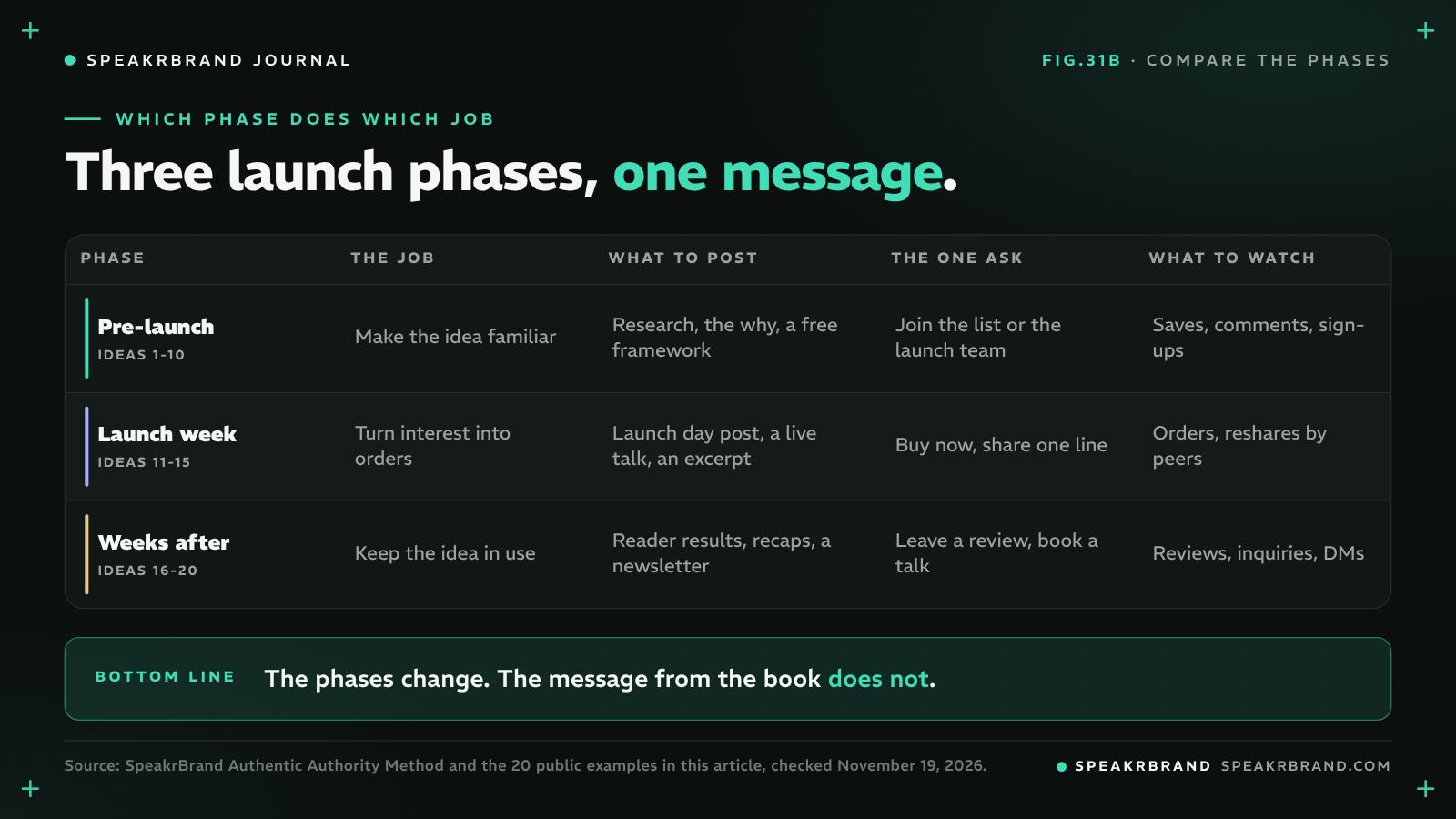
FIG.31B · The three launch phases compared: the job, what to post, the one ask, and what to watch. Tap to open full size.
The 20 ideas split into three phases, each with a different job. Pre-launch posts build familiarity and a list. Launch week posts turn interest into orders. Posts in the weeks after keep the idea in use and lead to reviews, speaking invitations, and inquiries. The table lists every idea with its phase, the job it does, and the public example.
| Idea | Phase | What it does | Public example |
|---|---|---|---|
| 1. Announce the message before the cover | Pre-launch | Starts the list early | Dorie Clark |
| 2. Show the research behind the book | Pre-launch | Proves the idea has depth | Daniel Pink |
| 3. Why you wrote this book | Pre-launch | Gives readers a reason to care | Jorge Titinger |
| 4. The cover reveal, with the promise | Pre-launch | Turns a visual into a benefit | Amy Edmondson, Saphia Fleury |
| 5. The chapter you cut | Pre-launch | Shows judgment and voice | Sunndram Shukla |
| 6. Give away your best idea | Pre-launch | Lets readers use the book early | Chris Dyer |
| 7. A quiz tied to the core idea | Pre-launch | Builds the email list | Gretchen Rubin |
| 8. The pre-order bonus | Pre-launch | Gives a reason to order now | Ethan Mollick, Julie Bee |
| 9. The launch team invitation | Pre-launch | Recruits the people who will share | Scott De Long, Demi-Leigh Tebow |
| 10. Ask the question the book answers | Pre-launch | Starts the conversation in comments | Dave Rudin |
| 11. Launch day: one line, one ask | Launch week | Converts interest into orders | Ethan Mollick |
| 12. A live conversation with a peer | Launch week | Borrows a second audience | Amy Edmondson and Josh Bersin |
| 13. An excerpt as a full post | Launch week | Lets the writing sell the book | Adam Grant |
| 14. Peers share the line they loved | Launch week | Puts proof in other feeds | Arianna Huffington |
| 15. Thank readers by quoting them | Launch week | Turns early reviews into proof | Sean Glaze |
| 16. The launch recap, as lessons | Weeks after | Keeps momentum past week one | Christina Wing |
| 17. Answer the question readers ask | Weeks after | Extends the idea with a story | Jason Brooks |
| 18. The accolade, with context | Weeks after | Gives late buyers a reason | Ethan Mollick |
| 19. A newsletter, one chapter at a time | Weeks after | Keeps the idea in the inbox | LinkedIn Newsletters |
| 20. The second launch moment | Weeks after | Restarts attention months later | Amy Edmondson |
Examples checked live on November 19, 2026. On a phone, swipe the table sideways to see every column.
How Often Should Authors Post on LinkedIn During a Book Launch?
Authors should post two to five times a week on LinkedIn through a book launch, and more during launch week if the content is ready. Buffer’s analysis of more than 2 million LinkedIn posts found that moving from one post a week to two to five added about 1,182 impressions per post and lifted engagement rate by 0.23 percentage points.
Format matters too. The same Buffer analysis found that carousels, which are PDF document posts, earned 278% more engagement than videos. A carousel is a natural home for idea 6 (your best framework) and idea 19 (one chapter at a time). For more post formats beyond the launch, see the top 20 LinkedIn post ideas for keynote speakers in 2027, which many author-speakers use once the book is out.
Spread the 20 ideas across about three months. Run ideas 1-10 over the eight to ten weeks before release, ideas 11-15 in launch week, and ideas 16-20 over the following month. Keep repeating the message from the book in each one.
Frequently Asked Questions
What should authors post on LinkedIn before a book launch?
Before a book launch, authors should post the research, the story behind the book, a free framework, and a clear next step such as a quiz, a pre-order bonus, or a launch team invitation. Each post should repeat the book’s one core message. The goal is for readers to know the idea before release day.
How early should an author start posting about a book on LinkedIn?
An author should start posting about the book’s ideas at least 90 days before launch, and earlier if possible. Dorie Clark announced her next book more than a year before its release and began building an email list right away. Pre-orders count toward first-week sales, so the months before launch carry real weight.
Should authors share parts of their book for free on LinkedIn?
Yes, authors should share their best ideas for free on LinkedIn. Readers who use one framework from the book tend to want the rest, and an excerpt is the strongest proof the writing is worth buying. Adam Grant posted a full excerpt from Hidden Potential for the LinkedIn Book Club during launch week.
What is a book launch team?
A book launch team is a group of readers who agree to read the book early and post about it during launch week. Authors usually recruit them from their network and email list, give them early access, and send ready-to-share captions and links. Clear instructions make the team far more likely to post.
How can an author keep book sales going after launch week?
An author can keep sales going after launch week by posting reader questions and results, press and podcast recaps, accolades with context, and a chapter-by-chapter newsletter. Second launch moments, such as a paperback release, restart attention months later. Each post should still point back to the book’s message.
A book launch on LinkedIn works when the same message shows up for months, in posts that each do one job. Pick the sentence your book exists to prove, choose the ideas from this list that fit your launch, and start with the first post this week. If you want help planning and writing the launch, SpeakrBrand’s LinkedIn and social media marketing for thought leaders team builds book launch content calendars with authors, and the Thought Leadership Growth Engine keeps the book’s message working long after launch, so readers trust you before hello.
The best book launch LinkedIn ideas for authors in 2027 are twenty posts that repeat one message from the book across three phases: the months before launch, launch week, and the weeks after. Each post does a single job, such as building the email list, recruiting a launch team, turning interest into orders, or keeping the idea in use after week one. The list below gives you all twenty, with a real author who has done each one in public.
Book launch advice often arrives as a strategy guide: build a platform, start early, collect emails. Authors who already accept the strategy still face a blank post box on a Tuesday morning. This article is the list of posts. Every idea ties back to the one sentence your book exists to prove, because readers remember a message they have seen many times more than a cover they saw once.
Last updated: November 19, 2026. Every example link below was checked live on that date.
TLDR
- Pick one message from the book first. Every one of the 20 posts should point back to it.
- Ideas 1-10 are for pre-launch, when the job is to make the idea familiar and fill your email list and launch team.
- Ideas 11-15 are for launch week, when the job is to turn interest into orders and get peers sharing.
- Ideas 16-20 are for the weeks after, when the job is reviews, reader results, and bookings that come from the book.
- Earn Trust Before Hello: by launch day, readers should already know the book's idea and why it matters to them.
Why Do Authors Need a List of Book Launch Posts for 2027?
Authors need a list of posts because a book launch on LinkedIn is a season of publishing, and a guide alone does not tell you what to post on day 40. A list turns the strategy into drafts you can schedule, and it keeps every post tied to the same message instead of drifting into scattered announcements.
Timing matters well before release day. Penguin Random House tells its authors that pre-orders count toward your first week’s sales and that booksellers treat pre-order quantity as an early indicator of a book’s success. That puts real weight on the months before release, when you have no reviews and no bestseller badge. Dorie Clark has written in Harvard Business Review that successfully launching a book is harder than you might think, even for authors with a strong network.
LinkedIn is where business and leadership readers already spend part of their workday. The 2024 Edelman-LinkedIn B2B Thought Leadership Impact Report found that 52% of decision-makers spend an hour or more each week reading thought leadership content, and 75% said a piece of thought leadership led them to research a product or service they were not considering. For a nonfiction author, that is the reader who buys the book, brings you in to speak, and hands copies to a team.
The launch is a season of posts. The message from the book is the one thing that stays the same in every one of them.
How Did SpeakrBrand Choose These 20 Book Launch LinkedIn Ideas?
FIG.31A · Top 20 book launch LinkedIn ideas for authors in 2027, by phase. Tap to open full size.
SpeakrBrand chose these 20 ideas with one test: does the post move a reader one step closer to the book while repeating its core message? Each idea also had to fit a specific launch phase, be something an author could draft in under an hour, and have a public example from a real author who has already posted it.
The ideas draw on SpeakrBrand’s work with 350+ thought leaders, many of them authors and author-speakers, and on the Authentic Authority Method, which balances posts that make people trust you as a person with posts that show your expertise. If you are new to that method, start with what Authentic Authority is and how the four content buckets work. If you are 90 days or more from launch, pair this list with how authors can build a LinkedIn audience in the 90 days before a book launch, which covers the audience-building plan these posts sit inside.
Try this first: the one-sentence test
Write the single sentence your book exists to prove, in words a reader would use. Then read your last five LinkedIn posts and mark which ones point back to that sentence. Every idea below should pass the same test before you publish it.
What Should Authors Post on LinkedIn Before the Book Launches?
Before launch, authors should post the ideas, research, and story behind the book, then give readers something to do now: join a list, take a quiz, claim a pre-order bonus, or join the launch team. The job of pre-launch posts is familiarity. By release day, your message should feel like something readers already know.
1. Announce the message before the cover
Announce the book by its argument as soon as the contract is public, long before a cover exists. Dorie Clark announced her next book project with Marshall Goldsmith and Alisa Cohn more than a year ahead of its Fall 2027 release, explained the gap it fills for coaches and consultants, invited readers to a free LinkedIn Live Q&A, and pointed them to an email sign-up. The early post gave her a list and a conversation before there was anything to buy.
2. Show the research behind the book
Readers trust a book more when they can see the work behind it. Daniel Pink built the World Regret Survey, which has now gathered more than 26,000 regrets from people in 134 countries, and posted a look at the database itself the day before The Power of Regret launched, with a pre-order link. A screenshot of your interviews, survey, or source notes does the same job for a smaller book.
3. Why you wrote this book
The origin post explains what problem pulled you into writing. Jorge Titinger’s "why I wrote this book" post connects soccer fields in Peru, Stanford, and years as a CEO to five leadership principles, then gives the launch date and a pre-order link. The story makes the book personal. The principles make it useful.
4. The cover reveal, with the promise
A cover reveal works best when the caption says what the reader will get. Amy Edmondson’s announcement of Right Kind of Wrong listed three things readers would learn about failure, then linked to pre-orders. Saphia Fleury’s cover reveal for her Bloomsbury book drew comments from readers reacting to the design. Pair the image with one sentence of promise so the reveal sells the idea as well as the art.
5. The chapter you cut
Material that did not make the book is perfect pre-launch content because it is new, specific, and shows your judgment. Sunndram Shukla wrote about the chapter he deleted from Master Sales in 15 Minutes and why the idea felt too big for a few pages. Readers get a behind-the-scenes look, and the post signals that the finished book was edited with care.
6. Give away your best idea
Authors often hold back their strongest material so readers have a reason to buy. The opposite works better: readers who use one idea from the book want the rest. Chris Dyer shared six ideas from his new keynote and book, Moments That Matter, nine days before the book launched, including the line that you have about 100 milliseconds before a first impression locks in. Teach one framework in full and let it sell the book.
7. A quiz tied to the core idea
An assessment lets readers apply the book to themselves in a few minutes and gives you a reason to collect an email. Gretchen Rubin’s Four Tendencies quiz is tied directly to her book of the same name, and her site reports that over 4.5 million people have taken it. Post your quiz with a short explanation of the result types and invite people to share theirs in the comments.
A lead magnet allows you to talk about the problem your book solves without exhausting the book itself. (Conner Krizancic, Founder and CEO of SpeakrBrand)
8. The pre-order bonus
Pre-order bonuses give readers a reason to buy now instead of on release day. Ethan Mollick paired a photo of his first physical copies with a pre-order bonus: a code for an AI interview that helps readers apply the book’s ideas to their own work. Julie Bee offered a six-step email and audio course called the BURNED Blueprint to readers who pre-ordered and submitted their receipt. Make the bonus useful on its own and keep it tied to the book’s core idea.
9. The launch team invitation
A launch team is the group of readers who agree to read early and post during launch week. Scott De Long asked readers to comment "ME" to join the launch team for You Win Again, Jack, right under his pre-order link. Demi-Leigh Tebow invited readers to join her book launch team with early access and a clear set of steps. Say exactly what members get and what you will ask of them.
10. Ask the question the book answers
A question post brings readers into the book’s argument before they own it. A week before launch, Dave Rudin described the gap between knowing and doing that his book addresses, then asked readers which leadership habit makes a difference when they actually practice it. Every comment is a reader telling you which part of the book matters to them.
What Should Authors Post on LinkedIn During Launch Week?
During launch week, authors should make buying easy, borrow other audiences, and let the writing speak. Keep each post to one clear ask: order the book, join the live session, or share one line. Launch week is also when your launch team and peers carry the message into feeds you cannot reach alone.
11. Launch day: one line, one ask
The launch day post should be short. Ethan Mollick’s launch day post for Co-Intelligence said the book was out, linked one interview about it, and reminded readers that the pre-order bonus was still available through Friday. It drew more than 1,300 reactions. One line, one asset, one ask.
12. A live conversation with a peer
A live conversation puts your idea in front of a second audience. Amy Edmondson invited readers to a live discussion of Right Kind of Wrong with Josh Bersin during launch week, with a free copy for the first 500 people to register. On LinkedIn, members and Pages with more than 150 followers or connections are eligible to be evaluated for LinkedIn Live access, so apply well before launch.
13. An excerpt as a full post
The writing itself is the strongest proof that the book is worth reading. Adam Grant posted an excerpt from Hidden Potential for the LinkedIn Book Club, a full passage on spotting potential in job candidates, and it drew nearly 300 comments. Choose a passage that stands on its own and helps the reader do something the same day.
14. Peers share the line they loved
A peer quoting your book carries more weight than you quoting yourself. Before Hidden Potential came out, Arianna Huffington shared a line she loved from the book with the release date and a pre-order link. Dorie Clark congratulated John Lee Dumas on launch day and pointed her audience to his book and its bonuses. Clark has described how she built an automated launch team that pre-ordered, received an early copy, and got clear instructions on where and how to post. Send your team the lines, captions, and links so sharing takes a minute.
In one book launch SpeakrBrand supported, dozens of people posted about the book within a three-day window. The difference was preparation: a shared folder with ready-to-copy captions, graphics, and pre-order links, plus a specific ask for when to post.
15. Thank readers by quoting them
A thank-you post becomes social proof when it quotes real readers. Sean Glaze thanked early readers of What Effective Leaders Do, quoted two reader reviews word for word, and listed what the book teaches. Thank people by name when they agree, and quote the specific sentence they wrote.
What Should Authors Post on LinkedIn in the Weeks After Launch?
In the weeks after launch, authors should show the book at work: press, reader questions, results, and the talks it leads to. Launch week ends, and the book still needs readers. Posts in this phase keep the message moving and turn the book into speaking invitations and client conversations.
16. The launch recap, as lessons
A recap should share what happened and what it taught you. Christina Wing’s launch week post for Unspeakable listed the press coverage, two launch events, sessions with Harvard Business School students and executives, and a conference keynote, then asked readers for honest reviews. Podcast and media appearances deserve the same treatment. Jane Friedman’s roundup of what is working in podcast publicity for authors is a useful guide to booking those interviews.
A book about the things people avoid saying only matters if it gets people talking. (Christina Wing, on LinkedIn)
17. Answer the question readers ask
The questions readers send you are a list of future posts. Jason Brooks wrote that people kept asking how he took a 120-restaurant market from worst to first, and he answered it in a post about why he wrote The Simplicity of Leadership: cut complexity and focus on the priorities that matter. Answer one real reader question each week and point back to the chapter that goes deeper.
18. The accolade, with context
An award or list placement gives late buyers a reason to act. Ethan Mollick shared that Co-Intelligence made Amazon’s best books of the year so far in its category and the Financial Times summer business books list, months after launch. Add one sentence on what the recognition says about the idea, so the post teaches as well as announces.
19. A newsletter, one chapter at a time
A LinkedIn newsletter keeps the book’s idea in readers’ inboxes long after launch week. LinkedIn notes that newsletter subscribers are notified when you publish a new edition, including by email. Turn each chapter into one edition: the core idea, a story, and one action. Twelve chapters become a quarter of publishing.
20. The second launch moment
A book can launch more than once. Amy Edmondson announced the paperback of Right Kind of Wrong months after release, and mentioned its Financial Times Business Book of the Year award in the same post. Paperbacks, audiobooks, translations, and anniversaries all give you a fresh reason to post the same message to new readers.
How Do the 20 Book Launch LinkedIn Ideas Compare Side by Side?
FIG.31B · The three launch phases compared: the job, what to post, the one ask, and what to watch. Tap to open full size.
The 20 ideas split into three phases, each with a different job. Pre-launch posts build familiarity and a list. Launch week posts turn interest into orders. Posts in the weeks after keep the idea in use and lead to reviews, speaking invitations, and inquiries. The table lists every idea with its phase, the job it does, and the public example.
| Idea | Phase | What it does | Public example |
|---|---|---|---|
| 1. Announce the message before the cover | Pre-launch | Starts the list early | Dorie Clark |
| 2. Show the research behind the book | Pre-launch | Proves the idea has depth | Daniel Pink |
| 3. Why you wrote this book | Pre-launch | Gives readers a reason to care | Jorge Titinger |
| 4. The cover reveal, with the promise | Pre-launch | Turns a visual into a benefit | Amy Edmondson, Saphia Fleury |
| 5. The chapter you cut | Pre-launch | Shows judgment and voice | Sunndram Shukla |
| 6. Give away your best idea | Pre-launch | Lets readers use the book early | Chris Dyer |
| 7. A quiz tied to the core idea | Pre-launch | Builds the email list | Gretchen Rubin |
| 8. The pre-order bonus | Pre-launch | Gives a reason to order now | Ethan Mollick, Julie Bee |
| 9. The launch team invitation | Pre-launch | Recruits the people who will share | Scott De Long, Demi-Leigh Tebow |
| 10. Ask the question the book answers | Pre-launch | Starts the conversation in comments | Dave Rudin |
| 11. Launch day: one line, one ask | Launch week | Converts interest into orders | Ethan Mollick |
| 12. A live conversation with a peer | Launch week | Borrows a second audience | Amy Edmondson and Josh Bersin |
| 13. An excerpt as a full post | Launch week | Lets the writing sell the book | Adam Grant |
| 14. Peers share the line they loved | Launch week | Puts proof in other feeds | Arianna Huffington |
| 15. Thank readers by quoting them | Launch week | Turns early reviews into proof | Sean Glaze |
| 16. The launch recap, as lessons | Weeks after | Keeps momentum past week one | Christina Wing |
| 17. Answer the question readers ask | Weeks after | Extends the idea with a story | Jason Brooks |
| 18. The accolade, with context | Weeks after | Gives late buyers a reason | Ethan Mollick |
| 19. A newsletter, one chapter at a time | Weeks after | Keeps the idea in the inbox | LinkedIn Newsletters |
| 20. The second launch moment | Weeks after | Restarts attention months later | Amy Edmondson |
Examples checked live on November 19, 2026. On a phone, swipe the table sideways to see every column.
How Often Should Authors Post on LinkedIn During a Book Launch?
Authors should post two to five times a week on LinkedIn through a book launch, and more during launch week if the content is ready. Buffer’s analysis of more than 2 million LinkedIn posts found that moving from one post a week to two to five added about 1,182 impressions per post and lifted engagement rate by 0.23 percentage points.
Format matters too. The same Buffer analysis found that carousels, which are PDF document posts, earned 278% more engagement than videos. A carousel is a natural home for idea 6 (your best framework) and idea 19 (one chapter at a time). For more post formats beyond the launch, see the top 20 LinkedIn post ideas for keynote speakers in 2027, which many author-speakers use once the book is out.
Spread the 20 ideas across about three months. Run ideas 1-10 over the eight to ten weeks before release, ideas 11-15 in launch week, and ideas 16-20 over the following month. Keep repeating the message from the book in each one.
Frequently Asked Questions
What should authors post on LinkedIn before a book launch?
Before a book launch, authors should post the research, the story behind the book, a free framework, and a clear next step such as a quiz, a pre-order bonus, or a launch team invitation. Each post should repeat the book’s one core message. The goal is for readers to know the idea before release day.
How early should an author start posting about a book on LinkedIn?
An author should start posting about the book’s ideas at least 90 days before launch, and earlier if possible. Dorie Clark announced her next book more than a year before its release and began building an email list right away. Pre-orders count toward first-week sales, so the months before launch carry real weight.
Should authors share parts of their book for free on LinkedIn?
Yes, authors should share their best ideas for free on LinkedIn. Readers who use one framework from the book tend to want the rest, and an excerpt is the strongest proof the writing is worth buying. Adam Grant posted a full excerpt from Hidden Potential for the LinkedIn Book Club during launch week.
What is a book launch team?
A book launch team is a group of readers who agree to read the book early and post about it during launch week. Authors usually recruit them from their network and email list, give them early access, and send ready-to-share captions and links. Clear instructions make the team far more likely to post.
How can an author keep book sales going after launch week?
An author can keep sales going after launch week by posting reader questions and results, press and podcast recaps, accolades with context, and a chapter-by-chapter newsletter. Second launch moments, such as a paperback release, restart attention months later. Each post should still point back to the book’s message.
A book launch on LinkedIn works when the same message shows up for months, in posts that each do one job. Pick the sentence your book exists to prove, choose the ideas from this list that fit your launch, and start with the first post this week. If you want help planning and writing the launch, SpeakrBrand’s LinkedIn and social media marketing for thought leaders team builds book launch content calendars with authors, and the Thought Leadership Growth Engine keeps the book’s message working long after launch, so readers trust you before hello.