


The best AI website tips for keynote speakers in 2027 come down to one job: make your website the clearest, most consistent source on the internet for who you help, what you speak on, and why a planner should book you, so both the event planner and the AI tool the planner asks can describe you accurately. That means plain positioning on the homepage, pages built around the questions planners ask, text that AI crawlers can actually read, and a footprint across the web that repeats the same story.
Picture an event planner building a shortlist for a January sales kickoff. Instead of opening Google, the planner types one sentence into a chat window and gets five names back, with reasons attached. Every name on that list was stitched together from what the model could find and cite. The 15 tips below are how a speaker website earns a place in that answer. They are drawn from SpeakrBrand’s website work, 75+ websites developed for speakers and thought leaders, and from what Google, OpenAI, Anthropic, Perplexity, and Microsoft publish about how their AI search features find and use web pages. This is the list version of the AI Optimization for Speakers work SpeakrBrand does with clients, and it is not a generic SEO checklist.
Last updated: November 24, 2026. Every source link below was checked live on that date.
TLDR
- Event planners and the AI tools they ask both need the same thing from a speaker website: a clear answer to who you help, on what topic, with what result.
- Google says AI Overviews and AI Mode use the same SEO foundations as regular search, with no special files or schema required, so clarity and structure matter more than tricks.
- The 15 tips fall into five layers: Message, Structure, Pages, Technical, and Off-site.
- A speaker’s own site is only part of what AI tools read. McKinsey found brand sites make up 5 to 10 percent of the sources AI search references, so consistent third-party mentions matter.
- Test your AI visibility monthly with the same planner prompts, and fix the message layer before anything else.
Why Do Keynote Speakers Need an AI-Ready Website in 2027?
Keynote speakers need an AI-ready website because more buyers now ask an AI tool for recommendations before they ever visit a speaker’s site, and those tools can only recommend speakers they can find, read, and cite. In a Harvard Business Review article on optimizing brands for LLMs, David Dubois, John Dawson, and Akansh Jaiswal report a survey of 12,000 consumers in which 58 percent said they had turned to generative AI tools for product or service recommendations, up from 25 percent in 2023.
McKinsey’s October 2025 analysis, New front door to the internet, found that half of consumers now intentionally seek out AI-powered search, and that about 50 percent of Google searches already show AI summaries. When those summaries appear, fewer people click. A Pew Research Center analysis of 68,879 Google searches from March 2025 found that users who saw an AI summary clicked a traditional result in 8 percent of visits, compared with 15 percent when no summary appeared.
The tools themselves are built for this kind of question. ChatGPT search answers in plain language with links to sources, Claude web search returns cited responses, and Google says that with AI Mode people are asking Search more complex and longer questions. A planner asking for “a cybersecurity keynote speaker for a healthcare conference” is asking exactly the kind of question these tools are designed to answer.
Google ranks pages. AI synthesizes authority. If an AI tool summarized your website for an event planner today, the question is whether it would describe you accurately.
How Did SpeakrBrand Choose These 15 AI Website Tips?
SpeakrBrand chose these 15 tips by keeping only the changes that pass two tests at once: they help a human planner decide faster, and they help an AI tool describe the speaker accurately. Anything that only games a ranking factor was left out.
That filter matches what the platforms say. Google’s guide to AI features and your website states that the best practices for SEO remain relevant for AI Overviews and AI Mode and that there are no additional requirements to appear in them. In a May 2025 post on succeeding in Google’s AI experiences, John Mueller of Google Search Relations advised site owners to focus on “unique, non-commodity content,” noting that people using AI search ask longer and more specific questions. Gartner made a similar point in its 2024 prediction on search volume and AI chatbots:
“Companies will need to focus on producing unique content that is useful to customers and prospective customers.” Alan Antin, Vice President Analyst, Gartner
For a speaker, unique content is the material no one else has: your stories, your framework, the rooms you have spoken in, and the results audiences took home. Earn Trust Before Hello applies to machines as well as people. By the time a planner reaches out, your website should already have answered the questions they were going to ask.
What Are the Top 15 AI Website Tips for Speakers in 2027?

FIG.36A · The 15 AI website tips for speakers, grouped by layer. Tap to open full size.
The 15 tips run in the order SpeakrBrand recommends working through them, from the words on your homepage to the way you measure results. Each group answers a different question an AI tool has to resolve before it can recommend a speaker.
What Should a Speaker Website Say So AI Tools Describe You Accurately?
A speaker website should say, in plain words and in the same words everywhere, who the speaker serves, what problem the keynote solves, and what changes for the audience. AI tools repeat what they can read, so vague language produces vague recommendations.
1. Say who you help in the first screen
Your homepage headline and the first lines under it should answer three questions: who you serve, what problem you solve, and what outcome you create. “Inspiring audiences to reach their potential” gives an AI tool nothing to match. “Keynotes on cyber risk for healthcare leadership teams” gives it a category, an audience, and a reason. The most common gap SpeakrBrand sees in speaker websites is a homepage that describes the speaker’s personality before it describes the client’s problem.
2. Own one topic category
An AI tool has to decide what you are known for before it can name you. A site that lists leadership, sales, resilience, wellness, and innovation as equal topics splits that signal five ways. Urs Koenig, a leadership speaker SpeakrBrand has worked with, narrowed from broad leadership expert to two words, Radical Humility, and that phrase now anchors his message. One message is easier for a planner to remember and easier for a model to repeat. SpeakrBrand’s guide on how speakers can become a category of one goes deeper on choosing that lane.
3. Match your bio everywhere
Your website is the source of truth. Your LinkedIn headline, bureau profiles, YouTube descriptions, podcast guest bios, and directory listings should use the same title, the same topic, and the same claims, and they should link back to the same site. When those details disagree, a model has to guess which version is right. When they match, the model can connect them into one entity worth naming. Schema.org even has a property for this, sameAs, which lets your site point to the official profiles that belong to you.
How Should Speaker Website Pages Be Structured for AI Search?
Speaker website pages should be structured so every section answers one question in its first sentence, under a heading that reads like the question a planner would ask. That structure helps a planner skim and gives an AI tool a clean passage it can quote.
4. Write headings as the questions planners ask
Planners and AI users type full sentences, so mirror them. Headings such as “What does this keynote cover for a sales kickoff?” or “Can this talk be delivered virtually?” match how buyers ask. Pew’s data shows why phrasing matters: 60 percent of Google searches that began with a question word produced an AI summary, and searches of 10 words or more produced one 53 percent of the time, compared with 8 percent for one- or two-word searches.
5. Answer first under every heading
Put the direct answer in the first one or two sentences, then add detail, proof, and examples. Buyers decide quickly. In LinkedIn and Edelman B2B thought leadership research, 55 percent of buyers said they move on if content does not hold their interest within the first minute. An answer-first paragraph serves that reader and gives an AI tool a self-contained passage to lift.
6. Use one H1, logical H2s, and supporting H3s
Each page should have one main heading that names the page’s subject, section headings beneath it, and subheadings inside those sections. Google’s SEO Starter Guide recommends breaking long content into sections with headings to help users navigate, and notes that heading order matters more for screen readers than for Google rankings. McKinsey’s AI search guidance still calls for clear headings and precise language, because a clean outline is what lets a planner skim and a model separate one answer from the next. Many speaker templates use heading tags for decoration, which hides the real outline of the page.
7. Put the important facts in text
A sizzle reel, a designed one-sheet PDF, and a logo wall of past clients can all be invisible to an AI tool if the same facts do not also appear as text on the page. Google’s AI features guide lists “making sure that important content is available in textual form” as a fundamental. Add a written summary or transcript beside your reel, list keynote titles and takeaways in HTML, and follow Google’s video best practices so your videos can be found and understood.
Which Pages Help AI Tools Match a Speaker to the Right Event?
Pages built for a specific industry, event type, or planner task help AI tools match a speaker to the request, because the more specific the page, the closer it fits a specific question. A single generic “Keynotes” page leaves the model to do the matching on its own.
8. Build industry and event-type landing pages
If you speak at technology conferences and sales kickoffs, give each its own page, such as “Keynote speaker for technology conferences” and “Sales kickoff keynote speaker.” Each page should explain what the talk covers for that audience, which formats work, and what past events in that category looked like. Google notes that AI Mode and AI Overviews may use a “query fan-out” technique that runs related searches across subtopics, and a specific page gives those searches something specific to find.
9. Go deep on your niche
One article on your topic is a mention. A series of articles, talk summaries, and videos on the same theme is a body of work that signals expertise. If you speak on leadership in technology, publish several pieces that approach that theme from different angles, rather than scattered posts on unrelated subjects. Google’s guidance on helpful, reliable, people-first content asks whether content shows first-hand expertise and depth of knowledge, which is exactly what a focused archive demonstrates.
10. Link related pages together
Connect each article to the keynote page it supports, each keynote page to its case studies and videos, and each industry page back to the core topic. Link leadership content to your leadership keynote page and sales content to your sales kickoff page. Google’s link best practices explain that Google uses links to find pages and that good anchor text makes it easier for people and Google to make sense of your content. Clear links turn a pile of pages into a topic cluster.
11. Publish a planner facts page
Planners and AI tools both look for logistics: keynote titles, formats, session lengths, virtual options, travel base, AV needs, and how to book. Put them on one page in plain text. If you are comfortable sharing fee guidance, a clear range or starting point answers a question AI tools are often asked. SpeakrBrand’s checklist of what to put on a meeting planner resource page covers the full set.
What Technical Steps Let AI Crawlers Read a Speaker Website?
The technical steps that matter most are letting AI search crawlers reach your pages and labeling your key facts with structured data that matches the visible page. A beautiful site that blocks the crawlers behind AI search cannot be cited by them.
12. Let AI search crawlers in
Check your robots.txt file and any firewall or bot-protection setting from your host or CDN. Each AI company separates its search crawler from its training crawler. OpenAI’s crawler documentation explains that sites opted out of OAI-SearchBot will not be shown in ChatGPT search answers, while GPTBot covers training. Anthropic’s crawler guide says disabling Claude-SearchBot may reduce your visibility in search results, and Perplexity’s crawler page recommends allowing PerplexityBot to appear in its results. For Google, robots.txt rules for Googlebot control AI features in Search, while Google-Extended is a separate choice about other Google AI systems. You can decline training and still allow search.
13. Add Person schema that matches the page
Structured data describes a page in a machine-readable format. For a speaker, Person markup can label your name, job title, topics, and official profiles, and Google’s ProfilePage documentation shows how sameAs links connect them. Keep expectations accurate. Google says no special schema is needed for AI features, the markup must match what is visible on the page, and since a 2023 change FAQ rich results show only for well-known government and health sites. Treat schema as a clarity layer, then validate it with Google’s Rich Results Test.
“You don’t need to create new machine readable files, AI text files, or markup to appear in these features.” Google Search Central, AI features and your website
How Do Speakers Earn and Measure AI Visibility Beyond Their Own Website?
Speakers earn AI visibility beyond their own website by being named on sources AI tools already trust, and they measure it by asking those tools the same planner questions every month. Your site is the hub, but the model checks what others say.
14. Earn mentions on sources AI tools trust
McKinsey’s analysis found that a brand’s own sites make up only 5 to 10 percent of the sources AI search references, with the rest coming from publishers, communities, and other third parties. For a speaker, that means podcast appearances, trade-press articles, conference agenda pages, bureau profiles, and articles quoting you. Each one should describe you with the same topic and link to your site. Research points the same way on your own pages: the Generative Engine Optimization study from Princeton and IIT Delhi researchers, presented at KDD 2024, found that adding citations, quotations, and statistics boosted visibility in generative engine responses by up to 40 percent, while keyword stuffing offered little to no improvement.
15. Test your AI visibility every month
Run five planner-style prompts in ChatGPT, Claude, Perplexity, Gemini, and Google AI Mode, such as “Who are the best speakers on [topic] for [industry] events?” and “Top keynote speakers on [topic] in 2027.” Log whether you appear, where, what the tool says, and which sources it cites. Then add platform data. Google counts traffic from AI Overviews and AI Mode inside the Web search type of the Search Console Performance report, and Microsoft’s AI Performance report in Bing Webmaster Tools shows when Copilot and Bing AI summaries cite your pages. Few brands do this yet: in McKinsey’s September 2025 survey of Fortune 500 consumer brand CMOs, just 16 percent said they systematically track AI search performance.
Try this first
Open ChatGPT, Claude, and Perplexity in three tabs. Type the exact sentence a planner in your category would type, such as “Who are the best keynote speakers on [your topic] for a [your industry] conference?” Write down whether your name appears, where it appears, what the tool says about you, and which pages it cites. That one page of notes is your baseline for every fix below.
How Do the 15 AI Website Tips Compare Side by Side?
The table below lists each tip with its layer, the specific action, and the signal that tells you it worked. Use it as a quarterly checklist for your speaker website.
| Tip | Layer | What to do | How you know it worked |
|---|---|---|---|
| 1. Say who you help in the first screen | Message | Rewrite the homepage headline: audience, problem, outcome | A stranger can repeat it back |
| 2. Own one topic category | Message | Pick the one category you want to be named for | Your name appears for that category prompt |
| 3. Match your bio everywhere | Message | Copy one approved bio to LinkedIn, bureaus, YouTube, podcasts | Same title and topic on every profile |
| 4. Write headings as planner questions | Structure | Turn page headings into the questions buyers type | Headings read like a planner FAQ |
| 5. Answer first under every heading | Structure | Put a one or two sentence answer under each heading | Each answer stands alone if quoted |
| 6. One H1, logical H2s and H3s | Structure | Fix pages with several H1s or skipped levels | The heading outline makes sense alone |
| 7. Put key facts in text | Structure | Add transcripts, topic text, and an HTML bio | Nothing important lives only in a video or PDF |
| 8. Build industry and event pages | Pages | Add one page per core industry or event type | A page exists for your top two event types |
| 9. Go deep on your niche | Pages | Publish a series on your one topic | Several pieces support each keynote |
| 10. Link related pages together | Pages | Link articles to the matching keynote page | Every keynote page has inbound links |
| 11. Publish a planner facts page | Pages | List topics, formats, logistics, and booking steps | A planner finds answers without emailing |
| 12. Let AI search crawlers in | Technical | Review robots.txt and firewall rules | Search crawlers are allowed |
| 13. Add Person schema that matches | Technical | Mark up name, title, topic, and profiles | Rich Results Test shows no errors |
| 14. Earn mentions AI tools trust | Off-site | Pitch podcasts, trade press, and event agendas | New third-party pages name your topic |
| 15. Test your AI visibility monthly | Off-site | Run the same planner prompts and log results | A monthly log with names and sources |
Sources for each tip are linked in the sections above, checked November 24, 2026. On a phone, swipe the table sideways to see every column.
What Should Speakers Fix First on Their Website for AI Search?
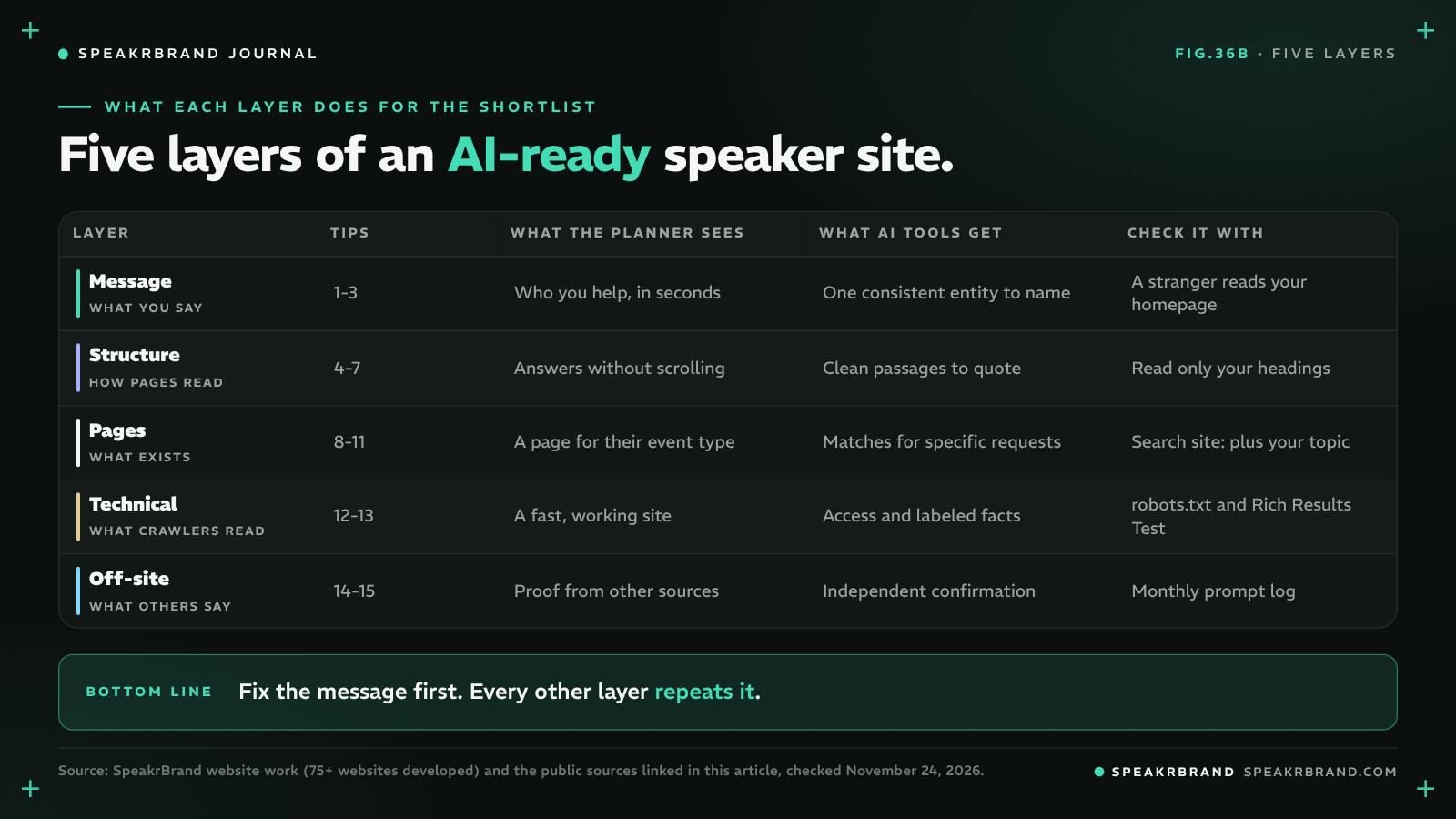
FIG.36B · The five layers of an AI-ready speaker site. Tap to open full size.
Speakers should fix the message layer first, because every other layer repeats it. If the homepage cannot say who you help in one sentence, better headings, more pages, and schema markup will only spread an unclear message further.
After the message, check crawler access, since a blocked site cannot be cited no matter how good it is. Then restructure your most important pages answer first, build one industry or event page for your strongest market, and start the monthly prompt log. Off-site mentions take the longest, so begin pitching podcasts and trade outlets in parallel. In SpeakrBrand’s experience across 350+ thought leaders supported, the speakers who get named most consistently are the ones whose website, LinkedIn, and bureau profiles all tell the same story. That is the 5P Playbook at work: Positioning sets the message, Presence and Proof carry it, and the website holds it together.
Frequently Asked Questions
What is AI search optimization for a speaker website?
AI search optimization for a speaker website is the work of making the site easy for AI tools such as ChatGPT, Claude, Perplexity, and Google AI Mode to find, understand, and cite. In practice it means clear positioning, question-based headings with direct answers, readable text, crawler access, and a consistent footprint across the web.
Do speakers need an llms.txt file for AI search?
Google says site owners do not need new machine-readable files, AI text files, or special markup to appear in AI Overviews or AI Mode. A speaker’s time is better spent on a clear homepage, answer-first pages, and crawler access before experimenting with optional files.
Should keynote speakers block AI crawlers?
Keynote speakers who want to be recommended in AI search should allow the search crawlers, such as OAI-SearchBot, Claude-SearchBot, PerplexityBot, and Googlebot. Training crawlers such as GPTBot and ClaudeBot are a separate choice, so a speaker can decline model training and still appear in AI search answers.
How long does it take for AI tools to reflect website changes?
Timing varies by platform. OpenAI says ChatGPT search can take about 24 hours to adjust after a robots.txt update, while Google notes that recrawling can take anywhere from several days to several months. Third-party mentions and model updates can take longer, which is why a monthly test log is more useful than daily checks.
Does FAQ schema still help speaker websites?
FAQ schema no longer produces FAQ rich results for most sites, because Google limited them to well-known government and health websites in 2023. Writing real planner questions and direct answers on the page still helps readers and AI tools, and markup that matches visible content does no harm.
How can I check whether ChatGPT recommends me as a speaker?
Type the exact question a planner in your category would ask, such as “Who are the best keynote speakers on [topic] for [industry] conferences?”, and note whether your name appears and which sources are cited. Repeat with four or five phrasings and in other tools, then repeat monthly to track change.
When a planner asks an AI tool for a speaker, the answer is built from whatever the web says about you, and your website is where that story should start. Work through these 15 tips one layer at a time, starting with the message. If you want a speaker website built for planners and AI search from the first line, SpeakrBrand’s speaker website development team designs and writes sites for keynote speakers, and the Speaker Brand Builder program brings your messaging, brand, website, and sales assets into one system. These tips are also the core of SpeakrBrand’s AI Optimization for Speakers webinar.
The best AI website tips for keynote speakers in 2027 come down to one job: make your website the clearest, most consistent source on the internet for who you help, what you speak on, and why a planner should book you, so both the event planner and the AI tool the planner asks can describe you accurately. That means plain positioning on the homepage, pages built around the questions planners ask, text that AI crawlers can actually read, and a footprint across the web that repeats the same story.
Picture an event planner building a shortlist for a January sales kickoff. Instead of opening Google, the planner types one sentence into a chat window and gets five names back, with reasons attached. Every name on that list was stitched together from what the model could find and cite. The 15 tips below are how a speaker website earns a place in that answer. They are drawn from SpeakrBrand’s website work, 75+ websites developed for speakers and thought leaders, and from what Google, OpenAI, Anthropic, Perplexity, and Microsoft publish about how their AI search features find and use web pages. This is the list version of the AI Optimization for Speakers work SpeakrBrand does with clients, and it is not a generic SEO checklist.
Last updated: November 24, 2026. Every source link below was checked live on that date.
TLDR
- Event planners and the AI tools they ask both need the same thing from a speaker website: a clear answer to who you help, on what topic, with what result.
- Google says AI Overviews and AI Mode use the same SEO foundations as regular search, with no special files or schema required, so clarity and structure matter more than tricks.
- The 15 tips fall into five layers: Message, Structure, Pages, Technical, and Off-site.
- A speaker’s own site is only part of what AI tools read. McKinsey found brand sites make up 5 to 10 percent of the sources AI search references, so consistent third-party mentions matter.
- Test your AI visibility monthly with the same planner prompts, and fix the message layer before anything else.
Why Do Keynote Speakers Need an AI-Ready Website in 2027?
Keynote speakers need an AI-ready website because more buyers now ask an AI tool for recommendations before they ever visit a speaker’s site, and those tools can only recommend speakers they can find, read, and cite. In a Harvard Business Review article on optimizing brands for LLMs, David Dubois, John Dawson, and Akansh Jaiswal report a survey of 12,000 consumers in which 58 percent said they had turned to generative AI tools for product or service recommendations, up from 25 percent in 2023.
McKinsey’s October 2025 analysis, New front door to the internet, found that half of consumers now intentionally seek out AI-powered search, and that about 50 percent of Google searches already show AI summaries. When those summaries appear, fewer people click. A Pew Research Center analysis of 68,879 Google searches from March 2025 found that users who saw an AI summary clicked a traditional result in 8 percent of visits, compared with 15 percent when no summary appeared.
The tools themselves are built for this kind of question. ChatGPT search answers in plain language with links to sources, Claude web search returns cited responses, and Google says that with AI Mode people are asking Search more complex and longer questions. A planner asking for “a cybersecurity keynote speaker for a healthcare conference” is asking exactly the kind of question these tools are designed to answer.
Google ranks pages. AI synthesizes authority. If an AI tool summarized your website for an event planner today, the question is whether it would describe you accurately.
How Did SpeakrBrand Choose These 15 AI Website Tips?
SpeakrBrand chose these 15 tips by keeping only the changes that pass two tests at once: they help a human planner decide faster, and they help an AI tool describe the speaker accurately. Anything that only games a ranking factor was left out.
That filter matches what the platforms say. Google’s guide to AI features and your website states that the best practices for SEO remain relevant for AI Overviews and AI Mode and that there are no additional requirements to appear in them. In a May 2025 post on succeeding in Google’s AI experiences, John Mueller of Google Search Relations advised site owners to focus on “unique, non-commodity content,” noting that people using AI search ask longer and more specific questions. Gartner made a similar point in its 2024 prediction on search volume and AI chatbots:
“Companies will need to focus on producing unique content that is useful to customers and prospective customers.” Alan Antin, Vice President Analyst, Gartner
For a speaker, unique content is the material no one else has: your stories, your framework, the rooms you have spoken in, and the results audiences took home. Earn Trust Before Hello applies to machines as well as people. By the time a planner reaches out, your website should already have answered the questions they were going to ask.
What Are the Top 15 AI Website Tips for Speakers in 2027?
FIG.36A · The 15 AI website tips for speakers, grouped by layer. Tap to open full size.
The 15 tips run in the order SpeakrBrand recommends working through them, from the words on your homepage to the way you measure results. Each group answers a different question an AI tool has to resolve before it can recommend a speaker.
What Should a Speaker Website Say So AI Tools Describe You Accurately?
A speaker website should say, in plain words and in the same words everywhere, who the speaker serves, what problem the keynote solves, and what changes for the audience. AI tools repeat what they can read, so vague language produces vague recommendations.
1. Say who you help in the first screen
Your homepage headline and the first lines under it should answer three questions: who you serve, what problem you solve, and what outcome you create. “Inspiring audiences to reach their potential” gives an AI tool nothing to match. “Keynotes on cyber risk for healthcare leadership teams” gives it a category, an audience, and a reason. The most common gap SpeakrBrand sees in speaker websites is a homepage that describes the speaker’s personality before it describes the client’s problem.
2. Own one topic category
An AI tool has to decide what you are known for before it can name you. A site that lists leadership, sales, resilience, wellness, and innovation as equal topics splits that signal five ways. Urs Koenig, a leadership speaker SpeakrBrand has worked with, narrowed from broad leadership expert to two words, Radical Humility, and that phrase now anchors his message. One message is easier for a planner to remember and easier for a model to repeat. SpeakrBrand’s guide on how speakers can become a category of one goes deeper on choosing that lane.
3. Match your bio everywhere
Your website is the source of truth. Your LinkedIn headline, bureau profiles, YouTube descriptions, podcast guest bios, and directory listings should use the same title, the same topic, and the same claims, and they should link back to the same site. When those details disagree, a model has to guess which version is right. When they match, the model can connect them into one entity worth naming. Schema.org even has a property for this, sameAs, which lets your site point to the official profiles that belong to you.
How Should Speaker Website Pages Be Structured for AI Search?
Speaker website pages should be structured so every section answers one question in its first sentence, under a heading that reads like the question a planner would ask. That structure helps a planner skim and gives an AI tool a clean passage it can quote.
4. Write headings as the questions planners ask
Planners and AI users type full sentences, so mirror them. Headings such as “What does this keynote cover for a sales kickoff?” or “Can this talk be delivered virtually?” match how buyers ask. Pew’s data shows why phrasing matters: 60 percent of Google searches that began with a question word produced an AI summary, and searches of 10 words or more produced one 53 percent of the time, compared with 8 percent for one- or two-word searches.
5. Answer first under every heading
Put the direct answer in the first one or two sentences, then add detail, proof, and examples. Buyers decide quickly. In LinkedIn and Edelman B2B thought leadership research, 55 percent of buyers said they move on if content does not hold their interest within the first minute. An answer-first paragraph serves that reader and gives an AI tool a self-contained passage to lift.
6. Use one H1, logical H2s, and supporting H3s
Each page should have one main heading that names the page’s subject, section headings beneath it, and subheadings inside those sections. Google’s SEO Starter Guide recommends breaking long content into sections with headings to help users navigate, and notes that heading order matters more for screen readers than for Google rankings. McKinsey’s AI search guidance still calls for clear headings and precise language, because a clean outline is what lets a planner skim and a model separate one answer from the next. Many speaker templates use heading tags for decoration, which hides the real outline of the page.
7. Put the important facts in text
A sizzle reel, a designed one-sheet PDF, and a logo wall of past clients can all be invisible to an AI tool if the same facts do not also appear as text on the page. Google’s AI features guide lists “making sure that important content is available in textual form” as a fundamental. Add a written summary or transcript beside your reel, list keynote titles and takeaways in HTML, and follow Google’s video best practices so your videos can be found and understood.
Which Pages Help AI Tools Match a Speaker to the Right Event?
Pages built for a specific industry, event type, or planner task help AI tools match a speaker to the request, because the more specific the page, the closer it fits a specific question. A single generic “Keynotes” page leaves the model to do the matching on its own.
8. Build industry and event-type landing pages
If you speak at technology conferences and sales kickoffs, give each its own page, such as “Keynote speaker for technology conferences” and “Sales kickoff keynote speaker.” Each page should explain what the talk covers for that audience, which formats work, and what past events in that category looked like. Google notes that AI Mode and AI Overviews may use a “query fan-out” technique that runs related searches across subtopics, and a specific page gives those searches something specific to find.
9. Go deep on your niche
One article on your topic is a mention. A series of articles, talk summaries, and videos on the same theme is a body of work that signals expertise. If you speak on leadership in technology, publish several pieces that approach that theme from different angles, rather than scattered posts on unrelated subjects. Google’s guidance on helpful, reliable, people-first content asks whether content shows first-hand expertise and depth of knowledge, which is exactly what a focused archive demonstrates.
10. Link related pages together
Connect each article to the keynote page it supports, each keynote page to its case studies and videos, and each industry page back to the core topic. Link leadership content to your leadership keynote page and sales content to your sales kickoff page. Google’s link best practices explain that Google uses links to find pages and that good anchor text makes it easier for people and Google to make sense of your content. Clear links turn a pile of pages into a topic cluster.
11. Publish a planner facts page
Planners and AI tools both look for logistics: keynote titles, formats, session lengths, virtual options, travel base, AV needs, and how to book. Put them on one page in plain text. If you are comfortable sharing fee guidance, a clear range or starting point answers a question AI tools are often asked. SpeakrBrand’s checklist of what to put on a meeting planner resource page covers the full set.
What Technical Steps Let AI Crawlers Read a Speaker Website?
The technical steps that matter most are letting AI search crawlers reach your pages and labeling your key facts with structured data that matches the visible page. A beautiful site that blocks the crawlers behind AI search cannot be cited by them.
12. Let AI search crawlers in
Check your robots.txt file and any firewall or bot-protection setting from your host or CDN. Each AI company separates its search crawler from its training crawler. OpenAI’s crawler documentation explains that sites opted out of OAI-SearchBot will not be shown in ChatGPT search answers, while GPTBot covers training. Anthropic’s crawler guide says disabling Claude-SearchBot may reduce your visibility in search results, and Perplexity’s crawler page recommends allowing PerplexityBot to appear in its results. For Google, robots.txt rules for Googlebot control AI features in Search, while Google-Extended is a separate choice about other Google AI systems. You can decline training and still allow search.
13. Add Person schema that matches the page
Structured data describes a page in a machine-readable format. For a speaker, Person markup can label your name, job title, topics, and official profiles, and Google’s ProfilePage documentation shows how sameAs links connect them. Keep expectations accurate. Google says no special schema is needed for AI features, the markup must match what is visible on the page, and since a 2023 change FAQ rich results show only for well-known government and health sites. Treat schema as a clarity layer, then validate it with Google’s Rich Results Test.
“You don’t need to create new machine readable files, AI text files, or markup to appear in these features.” Google Search Central, AI features and your website
How Do Speakers Earn and Measure AI Visibility Beyond Their Own Website?
Speakers earn AI visibility beyond their own website by being named on sources AI tools already trust, and they measure it by asking those tools the same planner questions every month. Your site is the hub, but the model checks what others say.
14. Earn mentions on sources AI tools trust
McKinsey’s analysis found that a brand’s own sites make up only 5 to 10 percent of the sources AI search references, with the rest coming from publishers, communities, and other third parties. For a speaker, that means podcast appearances, trade-press articles, conference agenda pages, bureau profiles, and articles quoting you. Each one should describe you with the same topic and link to your site. Research points the same way on your own pages: the Generative Engine Optimization study from Princeton and IIT Delhi researchers, presented at KDD 2024, found that adding citations, quotations, and statistics boosted visibility in generative engine responses by up to 40 percent, while keyword stuffing offered little to no improvement.
15. Test your AI visibility every month
Run five planner-style prompts in ChatGPT, Claude, Perplexity, Gemini, and Google AI Mode, such as “Who are the best speakers on [topic] for [industry] events?” and “Top keynote speakers on [topic] in 2027.” Log whether you appear, where, what the tool says, and which sources it cites. Then add platform data. Google counts traffic from AI Overviews and AI Mode inside the Web search type of the Search Console Performance report, and Microsoft’s AI Performance report in Bing Webmaster Tools shows when Copilot and Bing AI summaries cite your pages. Few brands do this yet: in McKinsey’s September 2025 survey of Fortune 500 consumer brand CMOs, just 16 percent said they systematically track AI search performance.
Try this first
Open ChatGPT, Claude, and Perplexity in three tabs. Type the exact sentence a planner in your category would type, such as “Who are the best keynote speakers on [your topic] for a [your industry] conference?” Write down whether your name appears, where it appears, what the tool says about you, and which pages it cites. That one page of notes is your baseline for every fix below.
How Do the 15 AI Website Tips Compare Side by Side?
The table below lists each tip with its layer, the specific action, and the signal that tells you it worked. Use it as a quarterly checklist for your speaker website.
| Tip | Layer | What to do | How you know it worked |
|---|---|---|---|
| 1. Say who you help in the first screen | Message | Rewrite the homepage headline: audience, problem, outcome | A stranger can repeat it back |
| 2. Own one topic category | Message | Pick the one category you want to be named for | Your name appears for that category prompt |
| 3. Match your bio everywhere | Message | Copy one approved bio to LinkedIn, bureaus, YouTube, podcasts | Same title and topic on every profile |
| 4. Write headings as planner questions | Structure | Turn page headings into the questions buyers type | Headings read like a planner FAQ |
| 5. Answer first under every heading | Structure | Put a one or two sentence answer under each heading | Each answer stands alone if quoted |
| 6. One H1, logical H2s and H3s | Structure | Fix pages with several H1s or skipped levels | The heading outline makes sense alone |
| 7. Put key facts in text | Structure | Add transcripts, topic text, and an HTML bio | Nothing important lives only in a video or PDF |
| 8. Build industry and event pages | Pages | Add one page per core industry or event type | A page exists for your top two event types |
| 9. Go deep on your niche | Pages | Publish a series on your one topic | Several pieces support each keynote |
| 10. Link related pages together | Pages | Link articles to the matching keynote page | Every keynote page has inbound links |
| 11. Publish a planner facts page | Pages | List topics, formats, logistics, and booking steps | A planner finds answers without emailing |
| 12. Let AI search crawlers in | Technical | Review robots.txt and firewall rules | Search crawlers are allowed |
| 13. Add Person schema that matches | Technical | Mark up name, title, topic, and profiles | Rich Results Test shows no errors |
| 14. Earn mentions AI tools trust | Off-site | Pitch podcasts, trade press, and event agendas | New third-party pages name your topic |
| 15. Test your AI visibility monthly | Off-site | Run the same planner prompts and log results | A monthly log with names and sources |
Sources for each tip are linked in the sections above, checked November 24, 2026. On a phone, swipe the table sideways to see every column.
What Should Speakers Fix First on Their Website for AI Search?
FIG.36B · The five layers of an AI-ready speaker site. Tap to open full size.
Speakers should fix the message layer first, because every other layer repeats it. If the homepage cannot say who you help in one sentence, better headings, more pages, and schema markup will only spread an unclear message further.
After the message, check crawler access, since a blocked site cannot be cited no matter how good it is. Then restructure your most important pages answer first, build one industry or event page for your strongest market, and start the monthly prompt log. Off-site mentions take the longest, so begin pitching podcasts and trade outlets in parallel. In SpeakrBrand’s experience across 350+ thought leaders supported, the speakers who get named most consistently are the ones whose website, LinkedIn, and bureau profiles all tell the same story. That is the 5P Playbook at work: Positioning sets the message, Presence and Proof carry it, and the website holds it together.
Frequently Asked Questions
What is AI search optimization for a speaker website?
AI search optimization for a speaker website is the work of making the site easy for AI tools such as ChatGPT, Claude, Perplexity, and Google AI Mode to find, understand, and cite. In practice it means clear positioning, question-based headings with direct answers, readable text, crawler access, and a consistent footprint across the web.
Do speakers need an llms.txt file for AI search?
Google says site owners do not need new machine-readable files, AI text files, or special markup to appear in AI Overviews or AI Mode. A speaker’s time is better spent on a clear homepage, answer-first pages, and crawler access before experimenting with optional files.
Should keynote speakers block AI crawlers?
Keynote speakers who want to be recommended in AI search should allow the search crawlers, such as OAI-SearchBot, Claude-SearchBot, PerplexityBot, and Googlebot. Training crawlers such as GPTBot and ClaudeBot are a separate choice, so a speaker can decline model training and still appear in AI search answers.
How long does it take for AI tools to reflect website changes?
Timing varies by platform. OpenAI says ChatGPT search can take about 24 hours to adjust after a robots.txt update, while Google notes that recrawling can take anywhere from several days to several months. Third-party mentions and model updates can take longer, which is why a monthly test log is more useful than daily checks.
Does FAQ schema still help speaker websites?
FAQ schema no longer produces FAQ rich results for most sites, because Google limited them to well-known government and health websites in 2023. Writing real planner questions and direct answers on the page still helps readers and AI tools, and markup that matches visible content does no harm.
How can I check whether ChatGPT recommends me as a speaker?
Type the exact question a planner in your category would ask, such as “Who are the best keynote speakers on [topic] for [industry] conferences?”, and note whether your name appears and which sources are cited. Repeat with four or five phrasings and in other tools, then repeat monthly to track change.
When a planner asks an AI tool for a speaker, the answer is built from whatever the web says about you, and your website is where that story should start. Work through these 15 tips one layer at a time, starting with the message. If you want a speaker website built for planners and AI search from the first line, SpeakrBrand’s speaker website development team designs and writes sites for keynote speakers, and the Speaker Brand Builder program brings your messaging, brand, website, and sales assets into one system. These tips are also the core of SpeakrBrand’s AI Optimization for Speakers webinar.


