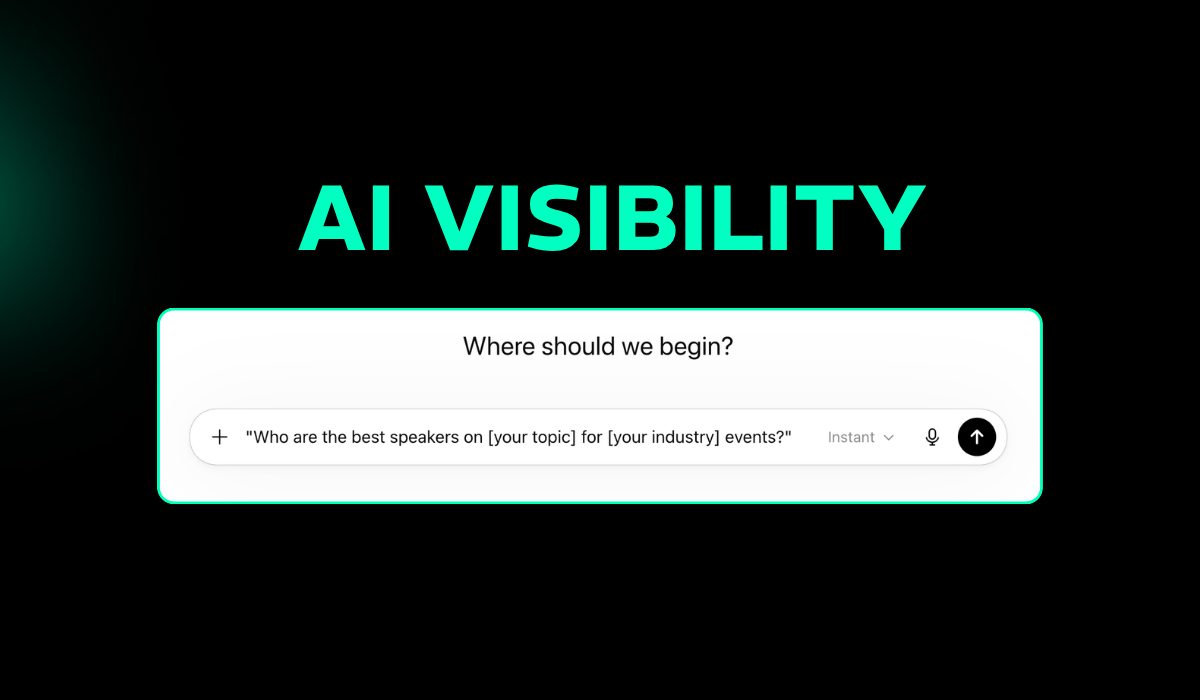
The way keynote speakers get found is changing faster than most realize. For two decades, getting discovered meant ranking on Google. A well-optimized website, a steady stream of blog posts, and a clean backlink profile were enough to surface in front of event planners searching for speakers. That model still works, but it is no longer sufficient. Event planners now ask ChatGPT, Gemini, and Perplexity who to hire before they ever open a search tab — and a different set of rules determines whether your name shows up in those answers.
This is the shift from SEO to AEO, and for keynote speakers it is the most consequential change in discoverability since LinkedIn became the default vetting platform. The speakers who understand both disciplines and execute them together will dominate the next decade of inbound bookings. The ones who treat AEO as a passing trend or assume their existing SEO investment is enough will quietly lose visibility in the channels where buyer decisions are now being made.
TLDR
- SEO focuses on ranking high in Google search results. AEO focuses on getting cited inside AI answers from ChatGPT, Gemini, and Perplexity.
- Nearly 60% of Google searches now end in zero clicks, meaning fewer buyers click through to websites and more rely on AI-generated summaries instead.
- For keynote speakers, AEO and SEO are not competing strategies. They work together. Strong SEO content is often what AI engines cite.
- Question-based headings, FAQ sections, statistics with sources, and structured long-form content correlate strongly with AI citations.
- Speakers who optimize for both disciplines build durable visibility across every channel buyers use, not just Google.
What Is the Difference Between AEO and SEO?
The difference between AEO and SEO is the destination. SEO optimizes for high rankings on a search engine results page. AEO optimizes for being cited as the answer inside an AI-generated response. Both rely on quality content, but they reward different structural choices and serve different parts of the buyer journey.
Traditional SEO is built on keywords, rankings, and click-through rates. The goal is to get a speaker's website to appear at the top of Google when a planner searches for terms like "leadership keynote speaker for healthcare." Backlinks, site authority, and topic clusters drive that performance. Search Engine Journal's research on SEO behavior shows that the top three Google results capture more than 50% of all clicks for a given query.
AEO works differently. AI engines do not rank pages. They synthesize answers from across the web and cite the sources that best fit a specific question. HubSpot defines AEO as the practice of improving how often and accurately a brand appears in AI-generated answers. For speakers, that means being the source ChatGPT cites when a planner asks, "Who are the best speakers on resilience for financial services audiences?"
"Google search tries to find the most authoritative page on the web. Answer engines try to find the best snippet to answer the question. The strategies that win each are related but not identical."
Why Do Keynote Speakers Need to Care About Both?
Keynote speakers need to care about both AEO and SEO because event planners use both channels at different points in their decision process. A planner might start by asking ChatGPT for a shortlist, then search Google to verify credentials, watch reels on YouTube, and finally visit a speaker's website to confirm fit. Each layer requires different visibility tactics.
The data confirms this multi-channel reality. Harvard Business Review's research on how professionals use generative AI found that research and shortlisting are among the most common business use cases for tools like ChatGPT and Claude. At the same time, Google still processes more than eight billion searches per day, meaning the traditional search engine remains the second stop in most buyer journeys.
For keynote speakers, this creates a clear strategic implication. Investing only in SEO captures the verification stage but misses the shortlist generation stage. Investing only in AEO captures the shortlist but loses momentum when planners cross-reference. The speakers who build durable inbound demand do both, and they do them in a way that reinforces each other.
"By the time an event planner emails you, you already passed three filters. Did AI mention you? Did Google verify you? Did your website convince them? If any one of those failed, you never knew you were in the running."
What Does Strong SEO Look Like for a Keynote Speaker?
Strong SEO for a keynote speaker looks like a website built around a clear positioning statement, supported by topic clusters that cover the speaker's core expertise, with industry-specific pages and consistent technical optimization. The goal is to rank for the queries planners use when they have already narrowed their search to a specific area.
The structural elements that matter most include:
- A homepage that clearly names the audience served, problem solved, and outcome delivered above the fold
- Industry-specific landing pages for the verticals the speaker targets, such as technology, healthcare, or financial services
- Topic-cluster content that covers the speaker's core expertise across multiple angles
- A regularly updated blog that demonstrates current thought leadership
- Clean technical performance, including fast page load, mobile responsiveness, and proper schema markup
- Quality backlinks from credible publications, podcasts, and partner organizations
According to SEMrush research on search behavior, websites that consistently publish quality content see 67% more leads than those that do not. For speakers, this means the blog is not optional. It is one of the most reliable inputs to long-term inbound visibility.
The mistake most speakers make with SEO is treating their website as a static brochure. Moz's research on modern SEO best practices emphasizes that ongoing publication, regular updates, and topic depth are now more important than backlink counts alone. A speaker who publishes one substantive blog post per month for two years will outrank a speaker with a beautiful but static site almost every time.
What Does Strong AEO Look Like for a Keynote Speaker?
Strong AEO for a keynote speaker looks like content explicitly structured to answer specific questions a planner might ask an AI tool. The format, structure, and clarity of the content matter as much as the substance. AI engines reward content that is direct, scannable, and rich with structural signals like question-based headings, FAQ sections, and inline statistics.
Specifically, Ahrefs's analysis of more than 17 million AI citations found that question-based headings correlate with citations across every major AI engine. Google AI Overviews showed a +28 correlation, Gemini +19, and AI Mode +7. FAQ schema produced similar results, with a +24 correlation in Google AI Overviews.
For keynote speakers, this translates into a specific publishing pattern:
- Blog post titles written as questions a planner would actually ask
- Section headings that answer specific sub-questions
- Direct one-sentence answers immediately after each heading, followed by supporting detail
- FAQ sections at the end of every long-form post
- Statistics with sources cited inline, not buried in footnotes
- Block quotes that pull out key insights for emphasis
- TLDR summaries near the top of long-form pieces
The other defining feature of AEO is recency. Ahrefs's research also found that AI engines cite content that is on average 25% more recent than what Google ranks. Four in ten AI citations drop after one month, and seven in ten are gone after six months. For speakers, this means updating existing content and publishing new posts consistently is not optional. It is how you stay in the citation pool.
"With answer engines, recency can push you back into the citation pool. A great post from 18 months ago might still rank on Google but will quietly disappear from ChatGPT."
How Do AEO and SEO Work Together for Speakers?
AEO and SEO work together for speakers because the foundation that drives SEO performance also drives AEO citation rate. AI engines pull heavily from content that already ranks well in traditional search, particularly in Google AI Overviews and Gemini. This means a strong SEO base is often the prerequisite for strong AEO results.
The integration plays out in three specific ways:
First, well-ranked SEO content gets cited more often by AI. HubSpot's research on AEO notes that Gemini, in particular, pulls heavily from pages already ranking in the top 20 search results. A speaker whose blog ranks for "how to give a TED talk" is more likely to be cited when someone asks ChatGPT the same question.
Second, the structural choices that improve AEO also improve SEO. Question-based headings, FAQ schema, fast page load, and clean technical performance all help with traditional search rankings. The two disciplines reinforce each other when executed well.
Third, brand authority signals that drive SEO also drive AEO. Backlinks, consistent entity signals, and credible mentions all increase the confidence with which AI engines reference a source. Forbes Communications Council research on AEO confirms that entity signals — the consistent set of information AI tools use to identify a brand across the web — are one of the strongest factors in citation confidence.
For speakers, the practical implication is clear. Build SEO foundations first. Then layer AEO structural choices on top. The compound effect of both is significantly greater than either alone.
What Should Keynote Speakers Prioritize Right Now?
Keynote speakers should prioritize three moves over the next six months: clarifying positioning so it works equally well in search and AI, publishing structured long-form content monthly, and auditing existing assets for both SEO and AEO performance. These three actions create durable visibility across every channel buyers use.
The positioning work comes first. A speaker whose positioning is vague will struggle to rank for specific queries on Google and will struggle to be cited for specific questions in ChatGPT. The fix is the same in both cases: a one-sentence positioning statement that names the audience, the outcome, and the expertise. "I help healthcare executives build psychologically safe teams through frameworks drawn from clinical leadership research" works for both search engines and AI engines because both reward specificity.
The content publishing is the engine. Deloitte's research on generative AI in marketing highlights that the brands building durable AI visibility are publishing consistently, not sporadically. For speakers, that means at least one substantive long-form blog post per month, structured around questions planners ask, with the format and signals AI engines reward.
The audit is the verification. Existing speaker websites often have outdated content, inconsistent positioning across pages, and missing structural elements like FAQ sections and question-based headings. A quarterly audit catches these gaps before they cost visibility.
Frequently Asked Questions
Is AEO replacing SEO for keynote speakers?
No. AEO is a complement to SEO, not a replacement. Most AI engines pull from content that already ranks well in traditional search, so strong SEO remains the foundation for strong AEO. The speakers who build durable visibility do both disciplines together.
Which AI engine should speakers prioritize for AEO?
Start with ChatGPT and Google's AI Overviews, since they currently drive the highest share of AI-influenced buyer behavior. Perplexity is growing quickly and worth tracking, especially for buyers in research-heavy industries. Gemini matters because it is integrated directly into Google search results.
How long does it take to see results from AEO efforts?
Most speakers begin seeing measurable improvements in AI visibility within 60 to 90 days of consistent execution. Initial improvements often appear in Perplexity and ChatGPT first, with Google AI Overviews following as Google's index updates.
Does social media content help with AEO?
Social posts rarely get cited directly by AI engines, but they support AEO indirectly by building consistent entity signals and driving traffic to long-form content that does get cited. LinkedIn content in particular contributes to the entity signals AI uses to evaluate speaker authority.
How often should keynote speakers update their websites for SEO and AEO?
Update existing high-traffic pages every three to six months and aim to publish new long-form content at least monthly. AI engines reward recency more than traditional search engines do, so a content schedule that worked for SEO five years ago is likely too slow for AEO today.
What is the single highest-impact move for a speaker starting both SEO and AEO from scratch?
Publish one well-structured, question-based long-form blog post on your core topic every month for 12 months. That single discipline builds the SEO ranking signals, the AEO citation signals, and the entity authority signals that drive every other channel forward.
The Speakers Who Win the Next Decade
The speakers who dominate the next decade of inbound demand will not be the loudest voices on social media or the most aggressive outbound prospectors. They will be the ones whose positioning is clearest, whose content is most structured, and whose digital presence shows up consistently across every channel a buyer touches.
That means showing up on Google when a planner verifies credentials. Showing up on ChatGPT when a planner builds a shortlist. Showing up on Perplexity when a planner researches a topic. And showing up on LinkedIn when a planner checks recent thought leadership. None of these channels work in isolation. All of them reward the same underlying foundation: clarity, consistency, and structured publishing over time.
The window to build this foundation before competitors catch on is still open. Join our upcoming webinar on building AEO and SEO visibility for keynote speakers to get the specific frameworks, tools, and templates our team uses to help thought leaders dominate both search and AI-driven discovery.
The way keynote speakers get found is changing faster than most realize. For two decades, getting discovered meant ranking on Google. A well-optimized website, a steady stream of blog posts, and a clean backlink profile were enough to surface in front of event planners searching for speakers. That model still works, but it is no longer sufficient. Event planners now ask ChatGPT, Gemini, and Perplexity who to hire before they ever open a search tab — and a different set of rules determines whether your name shows up in those answers.
This is the shift from SEO to AEO, and for keynote speakers it is the most consequential change in discoverability since LinkedIn became the default vetting platform. The speakers who understand both disciplines and execute them together will dominate the next decade of inbound bookings. The ones who treat AEO as a passing trend or assume their existing SEO investment is enough will quietly lose visibility in the channels where buyer decisions are now being made.
TLDR
- SEO focuses on ranking high in Google search results. AEO focuses on getting cited inside AI answers from ChatGPT, Gemini, and Perplexity.
- Nearly 60% of Google searches now end in zero clicks, meaning fewer buyers click through to websites and more rely on AI-generated summaries instead.
- For keynote speakers, AEO and SEO are not competing strategies. They work together. Strong SEO content is often what AI engines cite.
- Question-based headings, FAQ sections, statistics with sources, and structured long-form content correlate strongly with AI citations.
- Speakers who optimize for both disciplines build durable visibility across every channel buyers use, not just Google.
What Is the Difference Between AEO and SEO?
The difference between AEO and SEO is the destination. SEO optimizes for high rankings on a search engine results page. AEO optimizes for being cited as the answer inside an AI-generated response. Both rely on quality content, but they reward different structural choices and serve different parts of the buyer journey.
Traditional SEO is built on keywords, rankings, and click-through rates. The goal is to get a speaker's website to appear at the top of Google when a planner searches for terms like "leadership keynote speaker for healthcare." Backlinks, site authority, and topic clusters drive that performance. Search Engine Journal's research on SEO behavior shows that the top three Google results capture more than 50% of all clicks for a given query.
AEO works differently. AI engines do not rank pages. They synthesize answers from across the web and cite the sources that best fit a specific question. HubSpot defines AEO as the practice of improving how often and accurately a brand appears in AI-generated answers. For speakers, that means being the source ChatGPT cites when a planner asks, "Who are the best speakers on resilience for financial services audiences?"
"Google search tries to find the most authoritative page on the web. Answer engines try to find the best snippet to answer the question. The strategies that win each are related but not identical."
Why Do Keynote Speakers Need to Care About Both?
Keynote speakers need to care about both AEO and SEO because event planners use both channels at different points in their decision process. A planner might start by asking ChatGPT for a shortlist, then search Google to verify credentials, watch reels on YouTube, and finally visit a speaker's website to confirm fit. Each layer requires different visibility tactics.
The data confirms this multi-channel reality. Harvard Business Review's research on how professionals use generative AI found that research and shortlisting are among the most common business use cases for tools like ChatGPT and Claude. At the same time, Google still processes more than eight billion searches per day, meaning the traditional search engine remains the second stop in most buyer journeys.
For keynote speakers, this creates a clear strategic implication. Investing only in SEO captures the verification stage but misses the shortlist generation stage. Investing only in AEO captures the shortlist but loses momentum when planners cross-reference. The speakers who build durable inbound demand do both, and they do them in a way that reinforces each other.
"By the time an event planner emails you, you already passed three filters. Did AI mention you? Did Google verify you? Did your website convince them? If any one of those failed, you never knew you were in the running."
What Does Strong SEO Look Like for a Keynote Speaker?
Strong SEO for a keynote speaker looks like a website built around a clear positioning statement, supported by topic clusters that cover the speaker's core expertise, with industry-specific pages and consistent technical optimization. The goal is to rank for the queries planners use when they have already narrowed their search to a specific area.
The structural elements that matter most include:
- A homepage that clearly names the audience served, problem solved, and outcome delivered above the fold
- Industry-specific landing pages for the verticals the speaker targets, such as technology, healthcare, or financial services
- Topic-cluster content that covers the speaker's core expertise across multiple angles
- A regularly updated blog that demonstrates current thought leadership
- Clean technical performance, including fast page load, mobile responsiveness, and proper schema markup
- Quality backlinks from credible publications, podcasts, and partner organizations
According to SEMrush research on search behavior, websites that consistently publish quality content see 67% more leads than those that do not. For speakers, this means the blog is not optional. It is one of the most reliable inputs to long-term inbound visibility.
The mistake most speakers make with SEO is treating their website as a static brochure. Moz's research on modern SEO best practices emphasizes that ongoing publication, regular updates, and topic depth are now more important than backlink counts alone. A speaker who publishes one substantive blog post per month for two years will outrank a speaker with a beautiful but static site almost every time.
What Does Strong AEO Look Like for a Keynote Speaker?
Strong AEO for a keynote speaker looks like content explicitly structured to answer specific questions a planner might ask an AI tool. The format, structure, and clarity of the content matter as much as the substance. AI engines reward content that is direct, scannable, and rich with structural signals like question-based headings, FAQ sections, and inline statistics.
Specifically, Ahrefs's analysis of more than 17 million AI citations found that question-based headings correlate with citations across every major AI engine. Google AI Overviews showed a +28 correlation, Gemini +19, and AI Mode +7. FAQ schema produced similar results, with a +24 correlation in Google AI Overviews.
For keynote speakers, this translates into a specific publishing pattern:
- Blog post titles written as questions a planner would actually ask
- Section headings that answer specific sub-questions
- Direct one-sentence answers immediately after each heading, followed by supporting detail
- FAQ sections at the end of every long-form post
- Statistics with sources cited inline, not buried in footnotes
- Block quotes that pull out key insights for emphasis
- TLDR summaries near the top of long-form pieces
The other defining feature of AEO is recency. Ahrefs's research also found that AI engines cite content that is on average 25% more recent than what Google ranks. Four in ten AI citations drop after one month, and seven in ten are gone after six months. For speakers, this means updating existing content and publishing new posts consistently is not optional. It is how you stay in the citation pool.
"With answer engines, recency can push you back into the citation pool. A great post from 18 months ago might still rank on Google but will quietly disappear from ChatGPT."
How Do AEO and SEO Work Together for Speakers?
AEO and SEO work together for speakers because the foundation that drives SEO performance also drives AEO citation rate. AI engines pull heavily from content that already ranks well in traditional search, particularly in Google AI Overviews and Gemini. This means a strong SEO base is often the prerequisite for strong AEO results.
The integration plays out in three specific ways:
First, well-ranked SEO content gets cited more often by AI. HubSpot's research on AEO notes that Gemini, in particular, pulls heavily from pages already ranking in the top 20 search results. A speaker whose blog ranks for "how to give a TED talk" is more likely to be cited when someone asks ChatGPT the same question.
Second, the structural choices that improve AEO also improve SEO. Question-based headings, FAQ schema, fast page load, and clean technical performance all help with traditional search rankings. The two disciplines reinforce each other when executed well.
Third, brand authority signals that drive SEO also drive AEO. Backlinks, consistent entity signals, and credible mentions all increase the confidence with which AI engines reference a source. Forbes Communications Council research on AEO confirms that entity signals — the consistent set of information AI tools use to identify a brand across the web — are one of the strongest factors in citation confidence.
For speakers, the practical implication is clear. Build SEO foundations first. Then layer AEO structural choices on top. The compound effect of both is significantly greater than either alone.
What Should Keynote Speakers Prioritize Right Now?
Keynote speakers should prioritize three moves over the next six months: clarifying positioning so it works equally well in search and AI, publishing structured long-form content monthly, and auditing existing assets for both SEO and AEO performance. These three actions create durable visibility across every channel buyers use.
The positioning work comes first. A speaker whose positioning is vague will struggle to rank for specific queries on Google and will struggle to be cited for specific questions in ChatGPT. The fix is the same in both cases: a one-sentence positioning statement that names the audience, the outcome, and the expertise. "I help healthcare executives build psychologically safe teams through frameworks drawn from clinical leadership research" works for both search engines and AI engines because both reward specificity.
The content publishing is the engine. Deloitte's research on generative AI in marketing highlights that the brands building durable AI visibility are publishing consistently, not sporadically. For speakers, that means at least one substantive long-form blog post per month, structured around questions planners ask, with the format and signals AI engines reward.
The audit is the verification. Existing speaker websites often have outdated content, inconsistent positioning across pages, and missing structural elements like FAQ sections and question-based headings. A quarterly audit catches these gaps before they cost visibility.
Frequently Asked Questions
Is AEO replacing SEO for keynote speakers?
No. AEO is a complement to SEO, not a replacement. Most AI engines pull from content that already ranks well in traditional search, so strong SEO remains the foundation for strong AEO. The speakers who build durable visibility do both disciplines together.
Which AI engine should speakers prioritize for AEO?
Start with ChatGPT and Google's AI Overviews, since they currently drive the highest share of AI-influenced buyer behavior. Perplexity is growing quickly and worth tracking, especially for buyers in research-heavy industries. Gemini matters because it is integrated directly into Google search results.
How long does it take to see results from AEO efforts?
Most speakers begin seeing measurable improvements in AI visibility within 60 to 90 days of consistent execution. Initial improvements often appear in Perplexity and ChatGPT first, with Google AI Overviews following as Google's index updates.
Does social media content help with AEO?
Social posts rarely get cited directly by AI engines, but they support AEO indirectly by building consistent entity signals and driving traffic to long-form content that does get cited. LinkedIn content in particular contributes to the entity signals AI uses to evaluate speaker authority.
How often should keynote speakers update their websites for SEO and AEO?
Update existing high-traffic pages every three to six months and aim to publish new long-form content at least monthly. AI engines reward recency more than traditional search engines do, so a content schedule that worked for SEO five years ago is likely too slow for AEO today.
What is the single highest-impact move for a speaker starting both SEO and AEO from scratch?
Publish one well-structured, question-based long-form blog post on your core topic every month for 12 months. That single discipline builds the SEO ranking signals, the AEO citation signals, and the entity authority signals that drive every other channel forward.
The Speakers Who Win the Next Decade
The speakers who dominate the next decade of inbound demand will not be the loudest voices on social media or the most aggressive outbound prospectors. They will be the ones whose positioning is clearest, whose content is most structured, and whose digital presence shows up consistently across every channel a buyer touches.
That means showing up on Google when a planner verifies credentials. Showing up on ChatGPT when a planner builds a shortlist. Showing up on Perplexity when a planner researches a topic. And showing up on LinkedIn when a planner checks recent thought leadership. None of these channels work in isolation. All of them reward the same underlying foundation: clarity, consistency, and structured publishing over time.
The window to build this foundation before competitors catch on is still open. Join our upcoming webinar on building AEO and SEO visibility for keynote speakers to get the specific frameworks, tools, and templates our team uses to help thought leaders dominate both search and AI-driven discovery.