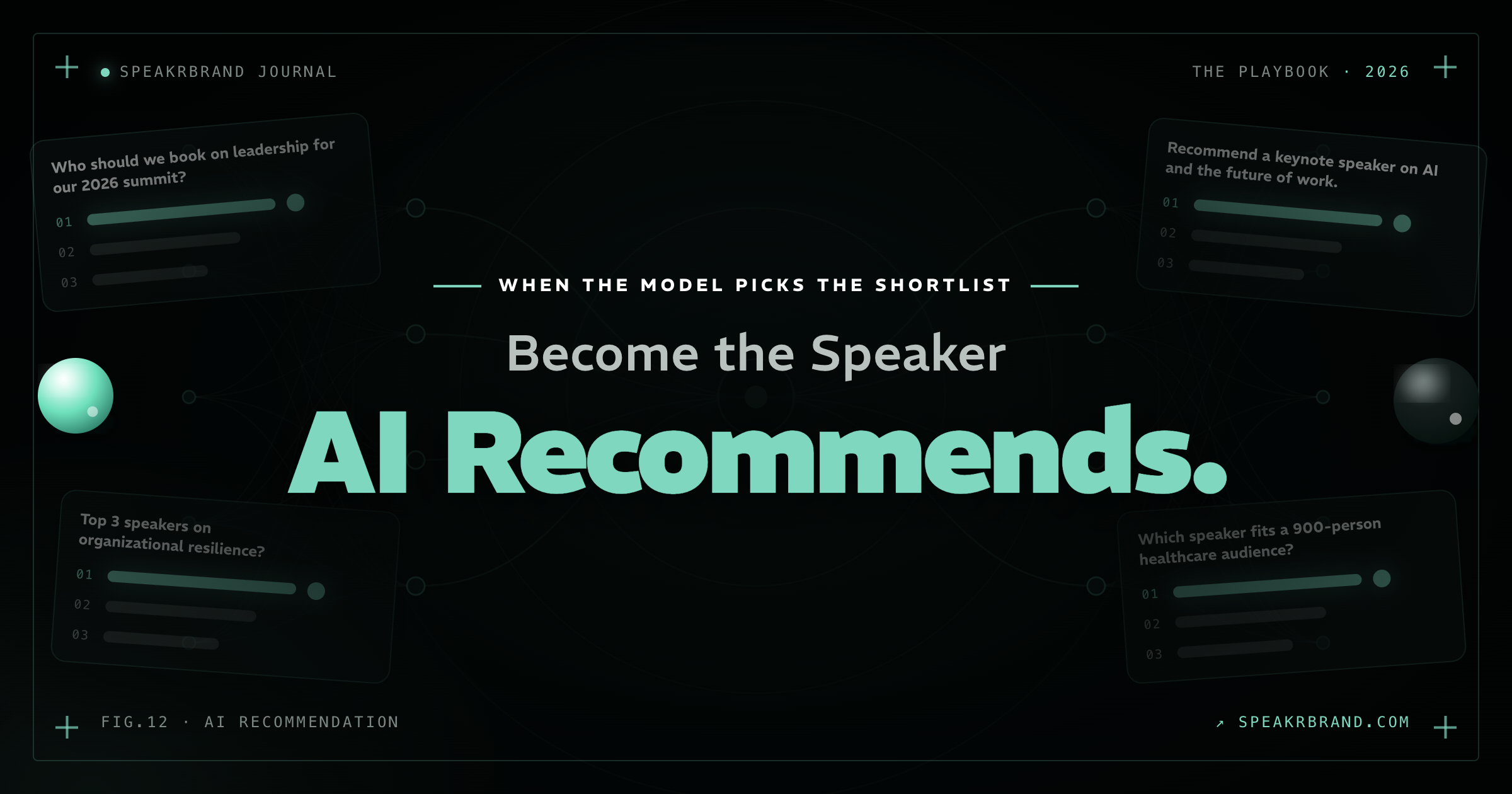
You become the speaker AI recommends by making your expertise interpretable: consistent positioning that states one clear thing, third-party references that corroborate it, and structured content that answers the exact questions planners ask. When a planner asks an answer engine who to book, the tool names the speakers whose digital footprint gives it something clear, credible, and consistent to cite. Expertise alone does not earn that mention. Interpretable expertise does.
This is the natural extension of a simple idea from the modern speaker's playbook: proof only works when a stranger can find it and understand it fast. Today that stranger is often a machine. Buyers now run their earliest research through AI, and Forrester reports the share of business buyers using AI in their process has reached 94 percent, with many naming it a more meaningful source than vendor websites or direct contact. Gartner predicts traditional search volume will fall 25 percent by 2026 as these engines absorb the query. The recommendation increasingly happens before a human ever reads your bio.
TLDR
- AI recommends speakers whose expertise is interpretable: clearly positioned, widely corroborated, and structured to answer real questions.
- Consistent positioning around one idea gives a model a category it can confidently place you in.
- Third-party references from bureaus, podcasts, and media build the authority AI trusts more than self-description.
- Structured, question-answering content is what answer engines lift directly into their recommendations.
- Being named is earned over time through consistency across every credible source, not bought or faked.
What Does It Mean for Your Expertise to Be Interpretable to AI?
Interpretable expertise is knowledge presented so clearly and consistently that a machine can understand what you do, confirm it, and repeat it. A model cannot sense your authority the way an audience can, so it relies on explicit signals: a plain statement of your focus, corroboration from other sources, and content it can parse.

The gap this closes is real. Decades of stage experience mean nothing to an answer engine if the record of that experience is scattered, vague, or absent online. This is why some of the most accomplished speakers get skipped while clearer, lesser-known experts get named. Interpretability is the bridge between what you have earned and what a machine can find. It is also increasingly the front door, since Pew Research Center found about half of U.S. adults now use AI chatbots, many to research and shortlist before making contact.
Expertise earns the stage. Interpretable expertise earns the recommendation from the tool a planner consults first.
Why Does Consistent Positioning Make AI More Likely to Name You?
Consistent positioning makes AI more likely to name you because a model recommends the speaker it can confidently categorize. When you own one clear idea and repeat it everywhere, the machine has an unambiguous answer to the question of what you speak about.
A speaker who talks about everything gives a model nothing specific to match against a planner's query. A speaker known for one sharp category becomes the obvious result. This mirrors how human decision-makers respond, since Edelman research shows they treat clear, substantive positioning as a more trustworthy basis for judgment than broad promotional language. The discipline is to choose the one conversation you want to own and to state it identically across your website, profiles, titles, and content, so that every source a model checks reinforces the same categorization rather than muddying it.
How Do Third-Party References Build the Authority AI Trusts?
Third-party references build authority because AI trusts consensus across independent sources more than anything you say about yourself. When bureaus, podcasts, conference pages, and media describe you the same way, a model reads it as verified expertise rather than self-promotion.

The evidence is direct. An Ahrefs analysis of 75,000 brands found that consistent third-party brand mentions correlate with AI visibility far more strongly than backlinks, with mentions inside video content showing the single strongest correlation of any factor. That last point deserves attention, given that Pew Research Center reports YouTube is the most widely used online platform in the United States, reaching 84 percent of adults and serving as a heavy source for AI tools. The practical move is to be talked about, accurately and consistently, in the places a model already trusts, so your authority is corroborated rather than merely claimed.
What other credible sources say about you now carries more weight with a machine than anything you say about yourself.
Why Does Structured, Question-Answering Content Get Cited?
Structured, question-answering content gets cited because answer engines assemble recommendations from text they can parse and lift directly. Content organized under clear headings, with direct answers to specific questions, is easy for a model to extract, while dense, meandering prose is not.
The format is the strategy. A page that poses the question a planner would actually ask, then answers it in the first sentence, gives a model a clean, self-contained response to reuse. FAQs, clear H2 and H3 structure, and articles written for a specific industry all multiply the moments a model can surface you for a relevant query. Consistency of output matters too, since LinkedIn and Edelman found nine in ten decision-makers are more receptive to those who publish substantive thinking consistently, and that steady body of work gives AI more evidence to draw from over time. This is Answer Engine Optimization in practice: not a separate trick, but the result of doing clear, structured, consistent content well enough that a model has something to cite.
How Do You Build a Presence AI Consistently Recommends?
You build a presence AI recommends by coordinating consistent positioning, third-party corroboration, and structured content across every surface a model reads. No single post does it. A consistent footprint across credible sources does.
Start by choosing and stating one clear category everywhere. Then earn and align third-party references so bureaus, podcasts, and media describe you the same way. Publish structured, question-answering content around your one idea on a steady cadence, and make sure your website and profiles reinforce it. Buyers move across many touchpoints while doing this research, and McKinsey found they use an average of ten channels, so consistency across all of them is what compounds into recommendation. Managing that footprint across a website, profiles, video, media, and bureau listings at once is precisely the work SpeakrBrand 360 was built to coordinate, because the presence that makes you interpretable to a machine is the same presence that makes you credible to the planner who books you.
Frequently Asked Questions
What does it mean to be the speaker AI recommends?
It means that when a planner asks an AI tool for speakers on a topic, your name appears in the synthesized answer. That happens when your positioning, third-party references, and content give the model enough clear, consistent, credible signal to include you.
Can I pay to be recommended by AI tools?
No. AI recommendations are earned through a body of content and references that the tools already trust, not purchased placements. The speaker most consistently and clearly represented across credible sources is the one most likely to be named.
How important is consistent positioning for AI recommendations?
It is central. A model can only recommend a speaker it can confidently categorize, so owning one clear idea and stating it identically everywhere makes you an obvious match for relevant queries. Talking about everything makes you specific to nothing.
Why do third-party mentions matter more than my own website?
AI builds confidence from consensus across independent sources, so consistent descriptions from bureaus, podcasts, and media carry more weight than self-description. Research shows third-party brand mentions correlate with AI visibility more strongly than traditional link metrics.
What kind of content is most likely to be cited by AI?
Content that is clearly structured and directly answers specific questions is easiest for a model to extract and reuse. FAQs, clear headings, and industry-specific articles that answer real planner questions tend to surface far more often than dense, unstructured prose.
Being named by an answer engine is not luck, and it is not fame. It is the compounding result of making your expertise interpretable: one clear category, corroborated by credible third parties, expressed in content a machine can read and reuse. The speakers who invest in that now will hold an advantage over those who wait, because answer engines, like every search engine before them, reward the ones who show up clearly and consistently first. To build a presence that both AI and event planners recommend, explore the resources and free strategy session at SpeakrBrand.
You become the speaker AI recommends by making your expertise interpretable: consistent positioning that states one clear thing, third-party references that corroborate it, and structured content that answers the exact questions planners ask. When a planner asks an answer engine who to book, the tool names the speakers whose digital footprint gives it something clear, credible, and consistent to cite. Expertise alone does not earn that mention. Interpretable expertise does.
This is the natural extension of a simple idea from the modern speaker's playbook: proof only works when a stranger can find it and understand it fast. Today that stranger is often a machine. Buyers now run their earliest research through AI, and Forrester reports the share of business buyers using AI in their process has reached 94 percent, with many naming it a more meaningful source than vendor websites or direct contact. Gartner predicts traditional search volume will fall 25 percent by 2026 as these engines absorb the query. The recommendation increasingly happens before a human ever reads your bio.
TLDR
- AI recommends speakers whose expertise is interpretable: clearly positioned, widely corroborated, and structured to answer real questions.
- Consistent positioning around one idea gives a model a category it can confidently place you in.
- Third-party references from bureaus, podcasts, and media build the authority AI trusts more than self-description.
- Structured, question-answering content is what answer engines lift directly into their recommendations.
- Being named is earned over time through consistency across every credible source, not bought or faked.
What Does It Mean for Your Expertise to Be Interpretable to AI?
Interpretable expertise is knowledge presented so clearly and consistently that a machine can understand what you do, confirm it, and repeat it. A model cannot sense your authority the way an audience can, so it relies on explicit signals: a plain statement of your focus, corroboration from other sources, and content it can parse.
The gap this closes is real. Decades of stage experience mean nothing to an answer engine if the record of that experience is scattered, vague, or absent online. This is why some of the most accomplished speakers get skipped while clearer, lesser-known experts get named. Interpretability is the bridge between what you have earned and what a machine can find. It is also increasingly the front door, since Pew Research Center found about half of U.S. adults now use AI chatbots, many to research and shortlist before making contact.
Expertise earns the stage. Interpretable expertise earns the recommendation from the tool a planner consults first.
Why Does Consistent Positioning Make AI More Likely to Name You?
Consistent positioning makes AI more likely to name you because a model recommends the speaker it can confidently categorize. When you own one clear idea and repeat it everywhere, the machine has an unambiguous answer to the question of what you speak about.
A speaker who talks about everything gives a model nothing specific to match against a planner's query. A speaker known for one sharp category becomes the obvious result. This mirrors how human decision-makers respond, since Edelman research shows they treat clear, substantive positioning as a more trustworthy basis for judgment than broad promotional language. The discipline is to choose the one conversation you want to own and to state it identically across your website, profiles, titles, and content, so that every source a model checks reinforces the same categorization rather than muddying it.
How Do Third-Party References Build the Authority AI Trusts?
Third-party references build authority because AI trusts consensus across independent sources more than anything you say about yourself. When bureaus, podcasts, conference pages, and media describe you the same way, a model reads it as verified expertise rather than self-promotion.
The evidence is direct. An Ahrefs analysis of 75,000 brands found that consistent third-party brand mentions correlate with AI visibility far more strongly than backlinks, with mentions inside video content showing the single strongest correlation of any factor. That last point deserves attention, given that Pew Research Center reports YouTube is the most widely used online platform in the United States, reaching 84 percent of adults and serving as a heavy source for AI tools. The practical move is to be talked about, accurately and consistently, in the places a model already trusts, so your authority is corroborated rather than merely claimed.
What other credible sources say about you now carries more weight with a machine than anything you say about yourself.
Why Does Structured, Question-Answering Content Get Cited?
Structured, question-answering content gets cited because answer engines assemble recommendations from text they can parse and lift directly. Content organized under clear headings, with direct answers to specific questions, is easy for a model to extract, while dense, meandering prose is not.
The format is the strategy. A page that poses the question a planner would actually ask, then answers it in the first sentence, gives a model a clean, self-contained response to reuse. FAQs, clear H2 and H3 structure, and articles written for a specific industry all multiply the moments a model can surface you for a relevant query. Consistency of output matters too, since LinkedIn and Edelman found nine in ten decision-makers are more receptive to those who publish substantive thinking consistently, and that steady body of work gives AI more evidence to draw from over time. This is Answer Engine Optimization in practice: not a separate trick, but the result of doing clear, structured, consistent content well enough that a model has something to cite.
How Do You Build a Presence AI Consistently Recommends?
You build a presence AI recommends by coordinating consistent positioning, third-party corroboration, and structured content across every surface a model reads. No single post does it. A consistent footprint across credible sources does.
Start by choosing and stating one clear category everywhere. Then earn and align third-party references so bureaus, podcasts, and media describe you the same way. Publish structured, question-answering content around your one idea on a steady cadence, and make sure your website and profiles reinforce it. Buyers move across many touchpoints while doing this research, and McKinsey found they use an average of ten channels, so consistency across all of them is what compounds into recommendation. Managing that footprint across a website, profiles, video, media, and bureau listings at once is precisely the work SpeakrBrand 360 was built to coordinate, because the presence that makes you interpretable to a machine is the same presence that makes you credible to the planner who books you.
Frequently Asked Questions
What does it mean to be the speaker AI recommends?
It means that when a planner asks an AI tool for speakers on a topic, your name appears in the synthesized answer. That happens when your positioning, third-party references, and content give the model enough clear, consistent, credible signal to include you.
Can I pay to be recommended by AI tools?
No. AI recommendations are earned through a body of content and references that the tools already trust, not purchased placements. The speaker most consistently and clearly represented across credible sources is the one most likely to be named.
How important is consistent positioning for AI recommendations?
It is central. A model can only recommend a speaker it can confidently categorize, so owning one clear idea and stating it identically everywhere makes you an obvious match for relevant queries. Talking about everything makes you specific to nothing.
Why do third-party mentions matter more than my own website?
AI builds confidence from consensus across independent sources, so consistent descriptions from bureaus, podcasts, and media carry more weight than self-description. Research shows third-party brand mentions correlate with AI visibility more strongly than traditional link metrics.
What kind of content is most likely to be cited by AI?
Content that is clearly structured and directly answers specific questions is easiest for a model to extract and reuse. FAQs, clear headings, and industry-specific articles that answer real planner questions tend to surface far more often than dense, unstructured prose.
Being named by an answer engine is not luck, and it is not fame. It is the compounding result of making your expertise interpretable: one clear category, corroborated by credible third parties, expressed in content a machine can read and reuse. The speakers who invest in that now will hold an advantage over those who wait, because answer engines, like every search engine before them, reward the ones who show up clearly and consistently first. To build a presence that both AI and event planners recommend, explore the resources and free strategy session at SpeakrBrand.