


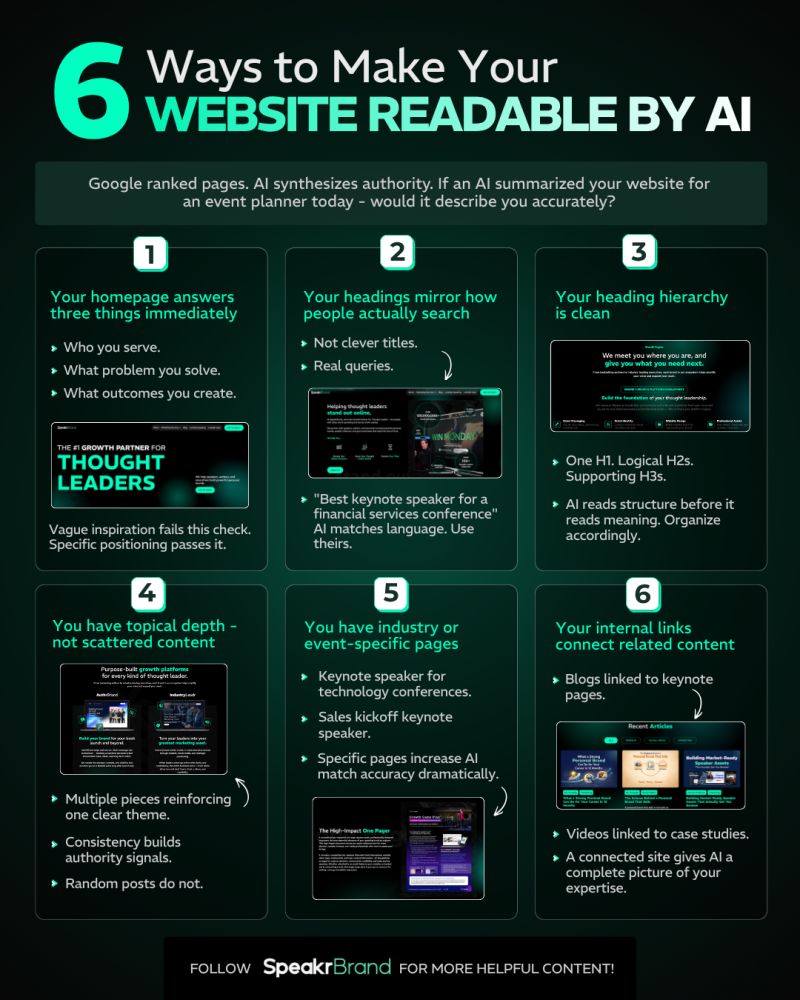
If an AI system summarized your keynote speaking website for an event planner today, would it describe your expertise with precision or confusion?
This question is no longer theoretical. AI-powered search tools are increasingly shaping how event organizers discover, evaluate, and shortlist speakers. Instead of scanning pages manually, planners are turning to tools that synthesize information and deliver direct recommendations.
Your website is no longer just a digital brochure. It is a primary data source that AI systems interpret, analyze, and present on your behalf.
The implication is clear. If your positioning is vague, your structure is inconsistent, or your content lacks depth, AI will struggle to understand you. And if AI cannot understand you, it cannot recommend you.
For keynote speakers, this shift represents both a risk and a significant opportunity.
AI Is Now Interpreting Your Speaking Brand

AI systems do not experience your website the way a human event planner does. They do not skim for inspiration or interpret tone intuitively. They extract meaning from structure, language, and context.
According to Harvard Business Review’s analysis of generative AI and search, these systems synthesize information across sources to generate clear, direct answers rather than presenting a list of options.
For keynote speakers, this means your homepage must immediately and explicitly answer three questions:
- Who you speak to
- What topics you cover
- What outcomes audiences walk away with
Language such as “inspiring transformation” or “unlocking potential” creates ambiguity. Specific positioning such as “keynote speaker on leadership in technology for enterprise teams” creates clarity.
AI does not reward poetic language. It rewards precision.
Structure Determines Whether AI Can Understand You
Before AI evaluates your ideas, it evaluates how your content is organized.
A well-structured keynote speaker website should follow a clear hierarchy:
- A single, focused H1 that defines your primary speaking category
- H2 sections that break down your core topics or audiences
- H3s that support specific use cases, industries, or event types
This hierarchy is not just a design choice. It is a communication system for machines. Research from MIT Sloan on AI-driven search behavior highlights that structured content is easier for AI to segment, categorize, and retrieve.
If your site lacks structure, your expertise becomes fragmented. If your structure is clear, your authority becomes legible.
Authority Comes From Depth in Your Speaking Niche

Many keynote speakers make the mistake of publishing broad, disconnected content in an attempt to appeal to wider audiences. AI interprets this as a lack of specialization.
Authority is built differently. It emerges from depth within a defined niche.
If you speak on leadership in technology, your content ecosystem should reflect that focus:
- Articles on leading technical teams
- Insights on digital transformation leadership
- Case studies from technology-driven organizations
This approach aligns with McKinsey’s perspective on the future of search, which emphasizes that consistent, reinforcing content signals expertise more effectively than isolated pieces.
For speakers, depth does not limit opportunity. It sharpens positioning and increases relevance in high-value contexts.
Event Planners Search in Questions, Not Keywords
The way event planners search has evolved. Queries are now conversational, specific, and tied to context.
Examples include:
- Best keynote speaker for a financial services conference
- Leadership keynote speaker for a sales kickoff event
- Technology speaker for an innovation summit
AI prioritizes content that mirrors these natural language queries. Research from the Stanford Institute for Human-Centered AI shows that systems perform more accurately when content aligns with how people naturally ask questions.
For keynote speakers, this creates a clear strategy. Build content around real audience questions. Use those questions as headings. Provide direct, structured answers.
This approach increases both discoverability and relevance.
Specific Landing Pages Win More Qualified Opportunities
Generic speaking pages are no longer sufficient. AI performs best when it can match highly specific intent with equally specific content.
Consider the difference:
- A single “Keynote Speaker” page
- Dedicated pages for “Technology Conference Keynote Speaker”
- Dedicated pages for “Sales Kickoff Keynote Speaker”
- Dedicated pages for “Leadership Speaker for Financial Services Events”
Each page creates a clear signal for AI to match with a specific type of event.
According to Deloitte’s research on AI-enabled search, clarity of context significantly improves match accuracy between user intent and content.
For keynote speakers, this translates directly into more qualified inquiries and stronger alignment with event needs.
Internal Linking Builds a Clear Map of Your Expertise
AI evaluates how your content connects. Internal linking creates a network that signals depth, relevance, and coherence.
Effective strategies include:
- Linking blog posts on leadership to your leadership keynote page
- Connecting sales-related content to your sales kickoff speaking page
- Tying case studies and testimonials to specific speaking topics
This structure mirrors how knowledge graphs function. It allows AI to understand relationships between ideas rather than viewing each page in isolation. Insights from Harvard Business Review on structured data systems reinforce that interconnected information improves interpretability.
When your content is connected, your expertise becomes easier to recognize and recommend.
The New Standard for Keynote Speaker Visibility
The shift underway is fundamental. Search engines once ranked your pages. AI systems now represent your speaking brand.
Ranking determined whether you appeared in results. Representation determines how accurately you are described and recommended.
For keynote speakers, this means your website must function as a clear, structured, and authoritative source of truth.
If an AI system were asked today to recommend a speaker for a specific event, would your website provide enough clarity for it to choose you?
If not, the path forward is clear. Sharpen your positioning. Strengthen your structure. Build depth within your niche.
AI is not replacing the speaker selection process. It is shaping it.
The speakers who adapt will not just be found more often. They will be understood more accurately and chosen more confidently.
If an AI system summarized your keynote speaking website for an event planner today, would it describe your expertise with precision or confusion?
This question is no longer theoretical. AI-powered search tools are increasingly shaping how event organizers discover, evaluate, and shortlist speakers. Instead of scanning pages manually, planners are turning to tools that synthesize information and deliver direct recommendations.
Your website is no longer just a digital brochure. It is a primary data source that AI systems interpret, analyze, and present on your behalf.
The implication is clear. If your positioning is vague, your structure is inconsistent, or your content lacks depth, AI will struggle to understand you. And if AI cannot understand you, it cannot recommend you.
For keynote speakers, this shift represents both a risk and a significant opportunity.
AI Is Now Interpreting Your Speaking Brand
AI systems do not experience your website the way a human event planner does. They do not skim for inspiration or interpret tone intuitively. They extract meaning from structure, language, and context.
According to Harvard Business Review’s analysis of generative AI and search, these systems synthesize information across sources to generate clear, direct answers rather than presenting a list of options.
For keynote speakers, this means your homepage must immediately and explicitly answer three questions:
- Who you speak to
- What topics you cover
- What outcomes audiences walk away with
Language such as “inspiring transformation” or “unlocking potential” creates ambiguity. Specific positioning such as “keynote speaker on leadership in technology for enterprise teams” creates clarity.
AI does not reward poetic language. It rewards precision.
Structure Determines Whether AI Can Understand You
Before AI evaluates your ideas, it evaluates how your content is organized.
A well-structured keynote speaker website should follow a clear hierarchy:
- A single, focused H1 that defines your primary speaking category
- H2 sections that break down your core topics or audiences
- H3s that support specific use cases, industries, or event types
This hierarchy is not just a design choice. It is a communication system for machines. Research from MIT Sloan on AI-driven search behavior highlights that structured content is easier for AI to segment, categorize, and retrieve.
If your site lacks structure, your expertise becomes fragmented. If your structure is clear, your authority becomes legible.
Authority Comes From Depth in Your Speaking Niche
Many keynote speakers make the mistake of publishing broad, disconnected content in an attempt to appeal to wider audiences. AI interprets this as a lack of specialization.
Authority is built differently. It emerges from depth within a defined niche.
If you speak on leadership in technology, your content ecosystem should reflect that focus:
- Articles on leading technical teams
- Insights on digital transformation leadership
- Case studies from technology-driven organizations
This approach aligns with McKinsey’s perspective on the future of search, which emphasizes that consistent, reinforcing content signals expertise more effectively than isolated pieces.
For speakers, depth does not limit opportunity. It sharpens positioning and increases relevance in high-value contexts.
Event Planners Search in Questions, Not Keywords
The way event planners search has evolved. Queries are now conversational, specific, and tied to context.
Examples include:
- Best keynote speaker for a financial services conference
- Leadership keynote speaker for a sales kickoff event
- Technology speaker for an innovation summit
AI prioritizes content that mirrors these natural language queries. Research from the Stanford Institute for Human-Centered AI shows that systems perform more accurately when content aligns with how people naturally ask questions.
For keynote speakers, this creates a clear strategy. Build content around real audience questions. Use those questions as headings. Provide direct, structured answers.
This approach increases both discoverability and relevance.
Specific Landing Pages Win More Qualified Opportunities
Generic speaking pages are no longer sufficient. AI performs best when it can match highly specific intent with equally specific content.
Consider the difference:
- A single “Keynote Speaker” page
- Dedicated pages for “Technology Conference Keynote Speaker”
- Dedicated pages for “Sales Kickoff Keynote Speaker”
- Dedicated pages for “Leadership Speaker for Financial Services Events”
Each page creates a clear signal for AI to match with a specific type of event.
According to Deloitte’s research on AI-enabled search, clarity of context significantly improves match accuracy between user intent and content.
For keynote speakers, this translates directly into more qualified inquiries and stronger alignment with event needs.
Internal Linking Builds a Clear Map of Your Expertise
AI evaluates how your content connects. Internal linking creates a network that signals depth, relevance, and coherence.
Effective strategies include:
- Linking blog posts on leadership to your leadership keynote page
- Connecting sales-related content to your sales kickoff speaking page
- Tying case studies and testimonials to specific speaking topics
This structure mirrors how knowledge graphs function. It allows AI to understand relationships between ideas rather than viewing each page in isolation. Insights from Harvard Business Review on structured data systems reinforce that interconnected information improves interpretability.
When your content is connected, your expertise becomes easier to recognize and recommend.
The New Standard for Keynote Speaker Visibility
The shift underway is fundamental. Search engines once ranked your pages. AI systems now represent your speaking brand.
Ranking determined whether you appeared in results. Representation determines how accurately you are described and recommended.
For keynote speakers, this means your website must function as a clear, structured, and authoritative source of truth.
If an AI system were asked today to recommend a speaker for a specific event, would your website provide enough clarity for it to choose you?
If not, the path forward is clear. Sharpen your positioning. Strengthen your structure. Build depth within your niche.
AI is not replacing the speaker selection process. It is shaping it.
The speakers who adapt will not just be found more often. They will be understood more accurately and chosen more confidently.


