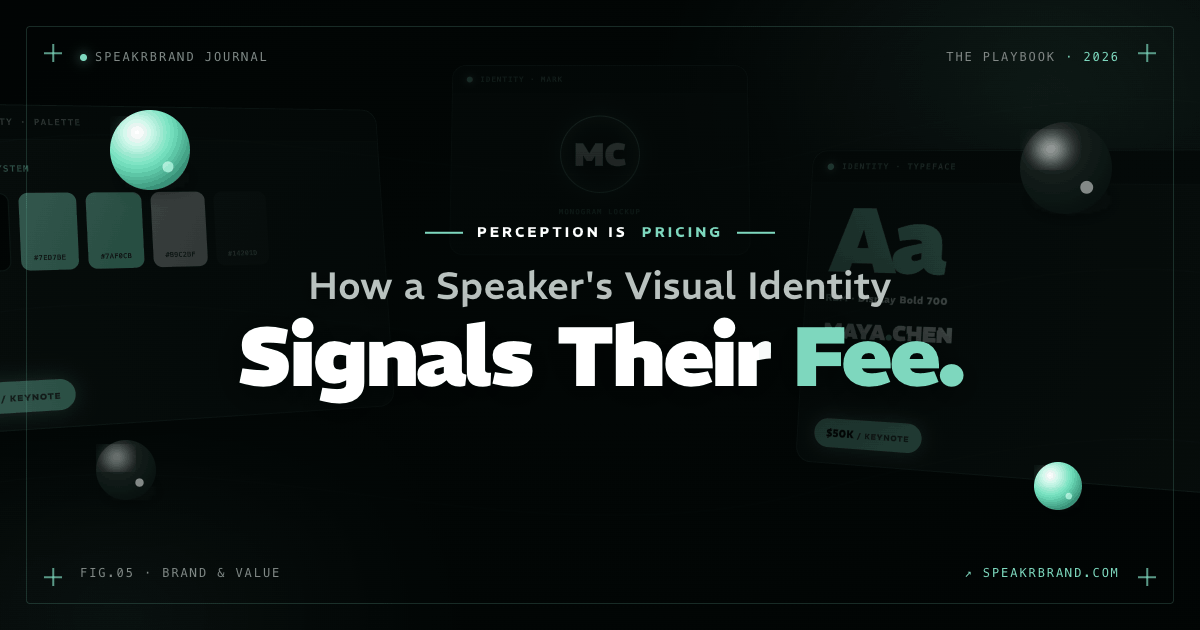
A speaker's visual identity signals their fee tier because event planners form a gut-level judgment about value within seconds of landing on a website, long before they read a single credential or ask about the rate. You can often sense whether someone is a 5,000 dollar speaker, a 15,000 dollar speaker, or a 25,000 dollar speaker by the time the page finishes loading. That sense has less to do with the speaker's resume and more to do with the assets carrying the brand.
This is uncomfortable for a lot of talented speakers. They assume the booking conversation starts when a planner emails or hops on a call. In reality, the planner has already filed a verdict on what you are worth. The visual brand set the ceiling before anyone said hello.

TLDR
- Event planners feel your fee tier in seconds, driven by visual assets more than credentials.
- People form trait judgments in about 100 milliseconds, and extra time mostly just hardens the verdict.
- The gap between a 5K brand and a 25K brand is positioning, photography, video, typography, and restraint.
- Consistent brand presentation is tied to revenue gains of up to 33 percent, because consistency reads as reliability.
- Fix your one-sentence positioning, your photography, and your reel before you touch anything else.
Can an Event Planner Really Sense Your Fee in Seconds?
Yes. A planner can sense your tier almost instantly, because the human brain renders snap judgments faster than conscious thought. Princeton researchers Janine Willis and Alexander Todorov found that people form trait impressions of a face, including trustworthiness and competence, after only a 100-millisecond exposure. More viewing time did not change the judgment. It only made people more confident in the one they had already made.
Websites work the same way. Research published in Behaviour and Information Technology shows viewers form an opinion about a site in roughly 50 milliseconds. Eye-tracking studies add that visitors take only a couple of seconds to land on the area that shapes their whole impression. So when a planner says they "felt" you were a premium speaker, they are not being vague. They are describing a fast, automatic process that ran before they could explain it.
People form trait judgments in about a tenth of a second. More time does not change the verdict. It only makes them more confident in the one they already reached.
What Separates a $5K Brand From a $25K Brand?
The difference between fee tiers is rarely talent. It is the quality and intentionality of the assets. The same keynote, wrapped in three different brands, will command three different fees because the brand is what the planner evaluates first.
A 5,000 dollar brand feels homemade. The headline is generic, often some version of "inspirational speaker." Headshots are basic. The layout is crowded, the fonts and colors are inconsistent, the testimonials carry no context, and there is no strong stage video. Nothing is wrong, exactly. It just signals amateur.
A 15,000 dollar brand feels established. The positioning names a clear niche. Photography is professional. The layout breathes, the typography is deliberate, recognizable logos appear, testimonials are focused, and there is a solid speaking reel. A planner reads competence.
A 25,000 dollar brand feels premium. Positioning is sharp and outcome-driven in a single sentence. Stage photography is cinematic. The design is minimal and confident, with a controlled color palette and typography that does not hedge. Proof appears immediately, the video is high quality, and every element looks chosen rather than accumulated. The restraint is the signal.

Why Do Planners Decide With Emotion Before Logic?
Planners decide with emotion first because visual quality is processed as a proxy for competence and trust. The Stanford Web Credibility Project found that nearly half of consumers, 46.1 percent, judged a site's credibility partly on the appeal of its visual design rather than its content. An estimated 94 percent of first impressions trace back to design and layout.
The Nielsen Norman Group calls the underlying mechanism the aesthetic-usability effect: people perceive attractive designs as more capable and more trustworthy, even when the substance is identical. Apply that to speakers, and a cinematic reel on a clean site does not just look nicer. It makes a planner assume the talk itself is sharper, the delivery more polished, and the risk lower.
Proof accelerates the same feeling. Edelman and LinkedIn's B2B research found that 75 percent of decision-makers said a strong piece of thought leadership prompted them to research a provider they had not previously considered. For a speaker, visible proof, meaning the reel, the logos, the specific testimonials, raises the number a planner is willing to imagine before the conversation begins.
How Does Visual Consistency Raise Your Fee Ceiling?
Consistency raises your ceiling because it reads as reliability, and reliability is exactly what a planner is buying when they put you on their stage. A brand that looks coherent across the website, the reel, the one-pager, and the social profiles tells a planner you will show up the same way in front of their audience.
The commercial case is documented. The Lucidpress State of Brand Consistency Report found that consistent brand presentation across channels is associated with revenue increases of up to 33 percent. The Nielsen Norman Group notes that aesthetics, used consistently, establish and reinforce a brand and its credibility. Inconsistency does the reverse. Three different headshot styles and two different versions of your name across pages quietly tell a planner the operation is improvised.
Premium design also wins by subtraction. In a Harvard Business Review study of thousands of consumers, the single biggest driver of customer loyalty was decision simplic
A speaker's visual identity signals their fee tier because event planners form a gut-level judgment about value within seconds of landing on a website, long before they read a single credential or ask about the rate. You can often sense whether someone is a 5,000 dollar speaker, a 15,000 dollar speaker, or a 25,000 dollar speaker by the time the page finishes loading. That sense has less to do with the speaker's resume and more to do with the assets carrying the brand.
This is uncomfortable for a lot of talented speakers. They assume the booking conversation starts when a planner emails or hops on a call. In reality, the planner has already filed a verdict on what you are worth. The visual brand set the ceiling before anyone said hello.
TLDR
- Event planners feel your fee tier in seconds, driven by visual assets more than credentials.
- People form trait judgments in about 100 milliseconds, and extra time mostly just hardens the verdict.
- The gap between a 5K brand and a 25K brand is positioning, photography, video, typography, and restraint.
- Consistent brand presentation is tied to revenue gains of up to 33 percent, because consistency reads as reliability.
- Fix your one-sentence positioning, your photography, and your reel before you touch anything else.
Can an Event Planner Really Sense Your Fee in Seconds?
Yes. A planner can sense your tier almost instantly, because the human brain renders snap judgments faster than conscious thought. Princeton researchers Janine Willis and Alexander Todorov found that people form trait impressions of a face, including trustworthiness and competence, after only a 100-millisecond exposure. More viewing time did not change the judgment. It only made people more confident in the one they had already made.
Websites work the same way. Research published in Behaviour and Information Technology shows viewers form an opinion about a site in roughly 50 milliseconds. Eye-tracking studies add that visitors take only a couple of seconds to land on the area that shapes their whole impression. So when a planner says they "felt" you were a premium speaker, they are not being vague. They are describing a fast, automatic process that ran before they could explain it.
People form trait judgments in about a tenth of a second. More time does not change the verdict. It only makes them more confident in the one they already reached.
What Separates a $5K Brand From a $25K Brand?
The difference between fee tiers is rarely talent. It is the quality and intentionality of the assets. The same keynote, wrapped in three different brands, will command three different fees because the brand is what the planner evaluates first.
A 5,000 dollar brand feels homemade. The headline is generic, often some version of "inspirational speaker." Headshots are basic. The layout is crowded, the fonts and colors are inconsistent, the testimonials carry no context, and there is no strong stage video. Nothing is wrong, exactly. It just signals amateur.
A 15,000 dollar brand feels established. The positioning names a clear niche. Photography is professional. The layout breathes, the typography is deliberate, recognizable logos appear, testimonials are focused, and there is a solid speaking reel. A planner reads competence.
A 25,000 dollar brand feels premium. Positioning is sharp and outcome-driven in a single sentence. Stage photography is cinematic. The design is minimal and confident, with a controlled color palette and typography that does not hedge. Proof appears immediately, the video is high quality, and every element looks chosen rather than accumulated. The restraint is the signal.
Why Do Planners Decide With Emotion Before Logic?
Planners decide with emotion first because visual quality is processed as a proxy for competence and trust. The Stanford Web Credibility Project found that nearly half of consumers, 46.1 percent, judged a site's credibility partly on the appeal of its visual design rather than its content. An estimated 94 percent of first impressions trace back to design and layout.
The Nielsen Norman Group calls the underlying mechanism the aesthetic-usability effect: people perceive attractive designs as more capable and more trustworthy, even when the substance is identical. Apply that to speakers, and a cinematic reel on a clean site does not just look nicer. It makes a planner assume the talk itself is sharper, the delivery more polished, and the risk lower.
Proof accelerates the same feeling. Edelman and LinkedIn's B2B research found that 75 percent of decision-makers said a strong piece of thought leadership prompted them to research a provider they had not previously considered. For a speaker, visible proof, meaning the reel, the logos, the specific testimonials, raises the number a planner is willing to imagine before the conversation begins.
How Does Visual Consistency Raise Your Fee Ceiling?
Consistency raises your ceiling because it reads as reliability, and reliability is exactly what a planner is buying when they put you on their stage. A brand that looks coherent across the website, the reel, the one-pager, and the social profiles tells a planner you will show up the same way in front of their audience.
The commercial case is documented. The Lucidpress State of Brand Consistency Report found that consistent brand presentation across channels is associated with revenue increases of up to 33 percent. The Nielsen Norman Group notes that aesthetics, used consistently, establish and reinforce a brand and its credibility. Inconsistency does the reverse. Three different headshot styles and two different versions of your name across pages quietly tell a planner the operation is improvised.
Premium design also wins by subtraction. In a Harvard Business Review study of thousands of consumers, the single biggest driver of customer loyalty was decision simplic