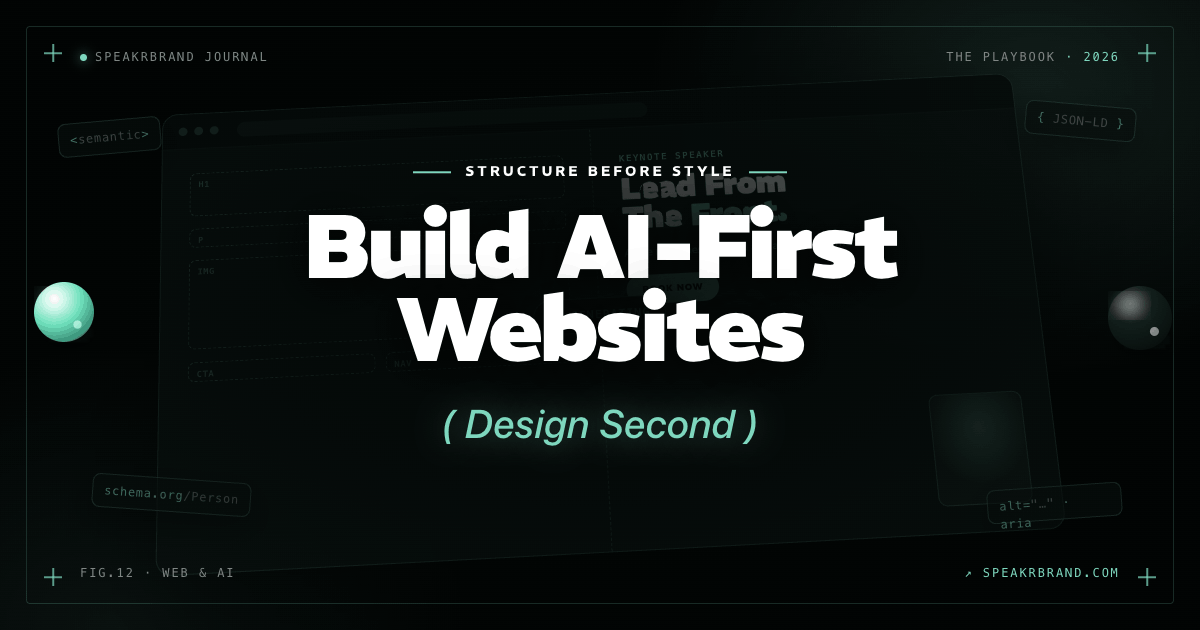
The best-looking speaker website does not always win the booking. The clearest one does. Design earns trust from humans in the first seconds, but clarity, in the form of plain positioning, structured headings, and content that answers real questions, is what lets AI tools understand and recommend you. The speakers winning now do both.
Audit enough speaker websites and a pattern appears. Some are beautiful, with premium photography, polished design, and smooth animations, yet an AI tool reading them has no idea what the speaker is actually about. Meanwhile a simpler site with one clear positioning statement, structured headings, helpful FAQs, and industry-specific content gets recommended. This matters because the research now happens in two places at once. McKinsey found the company website ranks among the top three touchpoints buyers use, and Pew Research Center found about half of U.S. adults now use AI chatbots, many of them to find and shortlist before they ever reach out.
TLDR
- The clearest speaker website beats the best-looking one, because clarity is what converts a visitor and what an AI can interpret.
- Design still matters, since humans judge credibility visually within milliseconds and rarely revise a poor first impression.
- AI cannot infer meaning from beautiful visuals, so it relies on clear text, structured headings, FAQs, and topical content.
- A clear, AI-readable site leads with one positioning statement above the fold and supports it with structure and industry-specific content.
- The future belongs to speakers who pair human-friendly design with machine-readable clarity.
Does the Best-Looking Speaker Website Actually Win the Booking?
No. The clearest website wins, not the most beautiful one. Beauty helps a visitor stay, but a planner books the speaker she can understand in seconds and remember later, and that depends on clarity far more than on visual polish.

A stunning site that requires a planner to dig for relevance loses to a plain one that states who it helps, what problem it solves, and what changes as a result. Decision-makers reward that substance, and Edelman research shows they treat clear, substantive positioning as a more trustworthy basis for judgment than polished promotion. Beauty and clarity are not in conflict. The mistake is treating design as the finish line when clarity is the actual job.
Why Does Design Still Matter for Human Trust?
Design matters because humans judge credibility visually within a fraction of a second, and that snap judgment shapes everything that follows. A site that looks neglected reads as a speaker who has not taken the work seriously.
The evidence on speed is striking. Research found that people form a visual first impression of a web page in about 50 milliseconds, and Stanford's Web Credibility research found that visual design is the factor people most often cite when deciding whether a site is credible, named in nearly half of their assessments. Those impressions are also durable, which is why Harvard research notes a weak first impression is hard to reverse, and why Harvard Business School research on trust shows credibility has to land before competence can persuade. Design is how a website earns the right to be read at all.
Why Does AI Need Clarity and Structure to Recommend You?
AI needs clarity because it cannot infer meaning from beautiful visuals the way a person can. A language model extracts what it understands from clear text, structured headings, and content that directly answers questions, and it skips what it cannot parse.

This is no longer a fringe concern. Gartner predicts traditional search volume will fall 25 percent by 2026 as answer engines absorb queries, which means more planners will meet your brand through a synthesized recommendation than through a list of links. What earns a place in that recommendation is interpretable signal. An Ahrefs analysis of 75,000 brands found that consistent, widely referenced brand signals correlate far more strongly with AI visibility than backlinks, and clear, well-structured content is what makes those signals legible. An animation cannot tell a model what you speak about. A clean heading and a direct sentence can.
A beautiful website that an AI cannot interpret is effectively invisible at the exact moment a planner asks a tool for a recommendation.
What Does a Clear, AI-Readable Speaker Website Include?
A clear, AI-readable speaker website leads with one positioning statement above the fold and supports it with structured headings, helpful FAQs, and industry-specific content. Each element does double duty, guiding a human and feeding a machine.
The positioning statement answers the core question instantly: who you help, what problem you solve, and what changes because of you. Structured headings let both a skimming planner and a parsing model find the answer without guessing. FAQs convert real questions into self-contained answers that an AI can lift directly. Industry-specific content, such as a blog post written for the exact audience a planner serves, gives the model more reasons to surface you for that audience. None of this requires sacrificing design, and all of it reinforces the website's job as a primary research surface, which matters given how much weight that channel carries in the buyer's journey.
How Can Speakers Win With Both Design and Clarity?
Speakers win by treating design and clarity as partners rather than trade-offs. Design builds trust with humans, clarity builds trust with AI, and the speakers who do both get chosen by the planner and surfaced by the tool she consults.
The practical path is to keep the polish and then make the meaning unmistakable. Start every page with a plain statement of value, organize the content under clean headings, answer the questions your audience actually asks, and keep the design working in service of the message rather than on top of it. Managing that balance across a website, profiles, and the other places a model looks is precisely the kind of presence SpeakrBrand 360 was built to coordinate, because the same clarity that converts a human visitor is what lets an answer engine recommend you with confidence.
Design builds trust with humans. Clarity builds trust with AI. The future belongs to speakers who can do both.
Frequently Asked Questions
What makes a speaker website effective for both humans and AI?
An effective site pairs clean, credible design with unmistakable clarity. Humans need a professional look and an instant sense of relevance, while AI needs clear text, structured headings, and direct answers it can extract. Doing both means the same site converts a planner and earns a recommendation from the tools she uses.
Does website design still matter if AI is doing the searching?
Yes. Once a human lands on your site, design shapes credibility within milliseconds and that impression is hard to reverse. AI may surface you, but a person still decides whether to book, so design and clarity both remain essential.
Why can't AI understand a beautiful website?
AI tools interpret text and structure, not visual artistry. Premium photography, animations, and layout do not tell a model what you speak about or who you help. Without clear positioning and parsable content, a beautiful site can leave an AI unable to describe or recommend you.
What should be above the fold on a speaker website?
Above the fold, a planner should immediately see who you help, what problem you solve, and what outcome you deliver, stated in one clear line. That single statement does the heaviest lifting for both human visitors and AI tools, because it answers the core question without requiring a scroll or a click.
Do FAQs and structured headings really help AI recommend me?
Yes. FAQs turn real questions into self-contained answers that AI can extract directly, and structured headings let a model locate the relevant point without guessing. Both make your expertise easier to interpret, which raises the odds of being included when a planner asks an AI for options.
Beautiful design and sharp clarity are not competing priorities. One earns a planner's trust in the first seconds, and the other earns a place in the answer when she asks an AI who to consider. Build for both, lead every page with a clear statement of value, and let the design serve the message rather than obscure it. To build a speaker website that planners and AI can both understand, explore the resources and free strategy session at SpeakrBrand.
The best-looking speaker website does not always win the booking. The clearest one does. Design earns trust from humans in the first seconds, but clarity, in the form of plain positioning, structured headings, and content that answers real questions, is what lets AI tools understand and recommend you. The speakers winning now do both.
Audit enough speaker websites and a pattern appears. Some are beautiful, with premium photography, polished design, and smooth animations, yet an AI tool reading them has no idea what the speaker is actually about. Meanwhile a simpler site with one clear positioning statement, structured headings, helpful FAQs, and industry-specific content gets recommended. This matters because the research now happens in two places at once. McKinsey found the company website ranks among the top three touchpoints buyers use, and Pew Research Center found about half of U.S. adults now use AI chatbots, many of them to find and shortlist before they ever reach out.
TLDR
- The clearest speaker website beats the best-looking one, because clarity is what converts a visitor and what an AI can interpret.
- Design still matters, since humans judge credibility visually within milliseconds and rarely revise a poor first impression.
- AI cannot infer meaning from beautiful visuals, so it relies on clear text, structured headings, FAQs, and topical content.
- A clear, AI-readable site leads with one positioning statement above the fold and supports it with structure and industry-specific content.
- The future belongs to speakers who pair human-friendly design with machine-readable clarity.
Does the Best-Looking Speaker Website Actually Win the Booking?
No. The clearest website wins, not the most beautiful one. Beauty helps a visitor stay, but a planner books the speaker she can understand in seconds and remember later, and that depends on clarity far more than on visual polish.
A stunning site that requires a planner to dig for relevance loses to a plain one that states who it helps, what problem it solves, and what changes as a result. Decision-makers reward that substance, and Edelman research shows they treat clear, substantive positioning as a more trustworthy basis for judgment than polished promotion. Beauty and clarity are not in conflict. The mistake is treating design as the finish line when clarity is the actual job.
Why Does Design Still Matter for Human Trust?
Design matters because humans judge credibility visually within a fraction of a second, and that snap judgment shapes everything that follows. A site that looks neglected reads as a speaker who has not taken the work seriously.
The evidence on speed is striking. Research found that people form a visual first impression of a web page in about 50 milliseconds, and Stanford's Web Credibility research found that visual design is the factor people most often cite when deciding whether a site is credible, named in nearly half of their assessments. Those impressions are also durable, which is why Harvard research notes a weak first impression is hard to reverse, and why Harvard Business School research on trust shows credibility has to land before competence can persuade. Design is how a website earns the right to be read at all.
Why Does AI Need Clarity and Structure to Recommend You?
AI needs clarity because it cannot infer meaning from beautiful visuals the way a person can. A language model extracts what it understands from clear text, structured headings, and content that directly answers questions, and it skips what it cannot parse.
This is no longer a fringe concern. Gartner predicts traditional search volume will fall 25 percent by 2026 as answer engines absorb queries, which means more planners will meet your brand through a synthesized recommendation than through a list of links. What earns a place in that recommendation is interpretable signal. An Ahrefs analysis of 75,000 brands found that consistent, widely referenced brand signals correlate far more strongly with AI visibility than backlinks, and clear, well-structured content is what makes those signals legible. An animation cannot tell a model what you speak about. A clean heading and a direct sentence can.
A beautiful website that an AI cannot interpret is effectively invisible at the exact moment a planner asks a tool for a recommendation.
What Does a Clear, AI-Readable Speaker Website Include?
A clear, AI-readable speaker website leads with one positioning statement above the fold and supports it with structured headings, helpful FAQs, and industry-specific content. Each element does double duty, guiding a human and feeding a machine.
The positioning statement answers the core question instantly: who you help, what problem you solve, and what changes because of you. Structured headings let both a skimming planner and a parsing model find the answer without guessing. FAQs convert real questions into self-contained answers that an AI can lift directly. Industry-specific content, such as a blog post written for the exact audience a planner serves, gives the model more reasons to surface you for that audience. None of this requires sacrificing design, and all of it reinforces the website's job as a primary research surface, which matters given how much weight that channel carries in the buyer's journey.
How Can Speakers Win With Both Design and Clarity?
Speakers win by treating design and clarity as partners rather than trade-offs. Design builds trust with humans, clarity builds trust with AI, and the speakers who do both get chosen by the planner and surfaced by the tool she consults.
The practical path is to keep the polish and then make the meaning unmistakable. Start every page with a plain statement of value, organize the content under clean headings, answer the questions your audience actually asks, and keep the design working in service of the message rather than on top of it. Managing that balance across a website, profiles, and the other places a model looks is precisely the kind of presence SpeakrBrand 360 was built to coordinate, because the same clarity that converts a human visitor is what lets an answer engine recommend you with confidence.
Design builds trust with humans. Clarity builds trust with AI. The future belongs to speakers who can do both.
Frequently Asked Questions
What makes a speaker website effective for both humans and AI?
An effective site pairs clean, credible design with unmistakable clarity. Humans need a professional look and an instant sense of relevance, while AI needs clear text, structured headings, and direct answers it can extract. Doing both means the same site converts a planner and earns a recommendation from the tools she uses.
Does website design still matter if AI is doing the searching?
Yes. Once a human lands on your site, design shapes credibility within milliseconds and that impression is hard to reverse. AI may surface you, but a person still decides whether to book, so design and clarity both remain essential.
Why can't AI understand a beautiful website?
AI tools interpret text and structure, not visual artistry. Premium photography, animations, and layout do not tell a model what you speak about or who you help. Without clear positioning and parsable content, a beautiful site can leave an AI unable to describe or recommend you.
What should be above the fold on a speaker website?
Above the fold, a planner should immediately see who you help, what problem you solve, and what outcome you deliver, stated in one clear line. That single statement does the heaviest lifting for both human visitors and AI tools, because it answers the core question without requiring a scroll or a click.
Do FAQs and structured headings really help AI recommend me?
Yes. FAQs turn real questions into self-contained answers that AI can extract directly, and structured headings let a model locate the relevant point without guessing. Both make your expertise easier to interpret, which raises the odds of being included when a planner asks an AI for options.
Beautiful design and sharp clarity are not competing priorities. One earns a planner's trust in the first seconds, and the other earns a place in the answer when she asks an AI who to consider. Build for both, lead every page with a clear statement of value, and let the design serve the message rather than obscure it. To build a speaker website that planners and AI can both understand, explore the resources and free strategy session at SpeakrBrand.